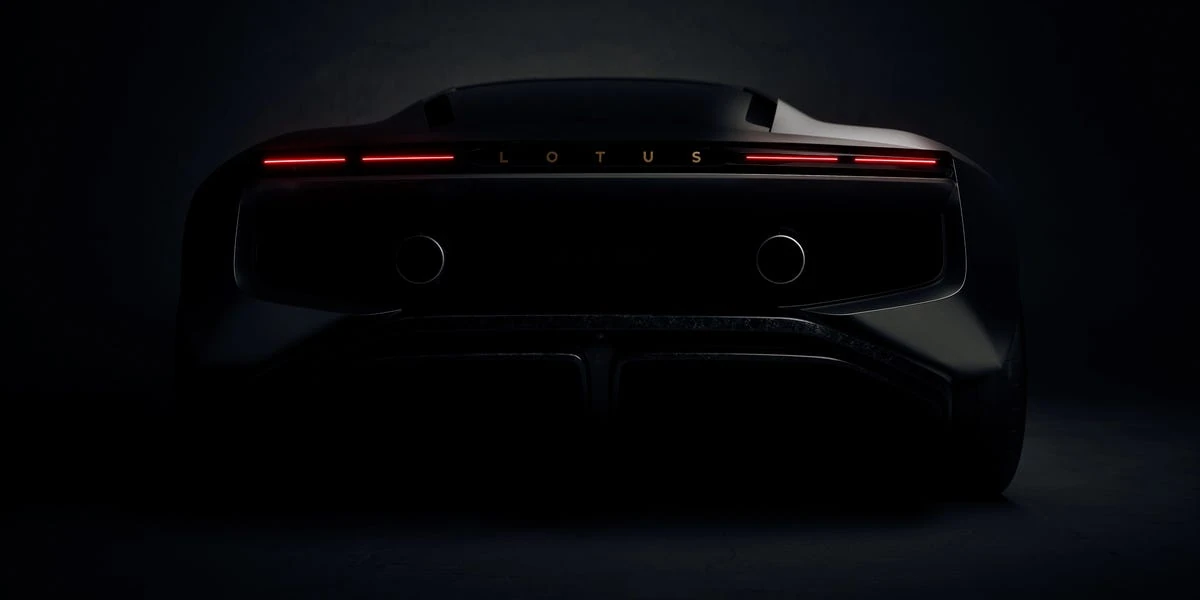
Lotus's upcoming supercar, known so far by the codename Type 135 and widely expected to revive the Esprit name, will be powered by a 670-hp 4.0-litre twin-turbo V-8 built by powertrain supplier Horse Powertrain. The engine is part of a hybrid system that Lotus says will deliver at least 986 horsepower in total.
Horse has confirmed details of the combustion side of the powertrain, which it calls the W40, along with an eight-speed dual-clutch automatic transmission it has developed in-house. Lotus plans to reveal and launch the car in 2028.
A hot-V V-8 designed for hybrid duty
The W40 is a 4.0-litre twin-turbocharged V-8 in a hot-V configuration, with the turbochargers mounted between the cylinder banks rather than on the outside of the engine. Horse quotes 670 horsepower and 590 pound-feet of torque from the combustion engine alone, at a weight of 441 pounds.
Horse says the engine was designed from the start around a hybrid system rather than adapted to one afterwards. Lotus's claim of at least 986 hp applies to the complete hybrid powertrain, not the V-8 on its own.
The gearbox is Horse's own eight-speed dual-clutch unit, the 8LDCT, using a wet dual clutch that the supplier says can deliver shift responses under 20 milliseconds, along with a silicon-carbide control system and a variable-displacement mechanical pump. Both the engine and transmission are set to make their debut in the Lotus.
Timing, naming and what is still open
Lotus intends to reveal and launch the model in 2028. The Esprit name is not yet officially attached: the car is confirmed only as Type 135, with the Esprit badge the widely expected choice.
Lotus has not announced pricing, the car's battery capacity, its electric-only range or charging figures, and no range test cycle has been published for the hybrid system. Those details are likely to arrive closer to the 2028 launch.
For buyers, the significance sits in the engine's output: a 670-hp V-8 forming part of a 986-hp-plus hybrid is a different proposition from the smaller forced-induction engines that have powered recent fast Lotuses. The choice of a bespoke V-8 and bespoke dual-clutch, rather than an off-the-shelf combination, suggests Lotus is treating this car as a flagship rather than a stopgap.