General Motors has filed a US patent application for a longitudinal variable-compression engine layout intended to be simpler to service, with the document published after being spotted by CarMoses. The filing describes replacing the centre link in GM's earlier variable-compression design with a two-piece assembly built around the crankshaft.
GM holds numerous patents on applying variable-compression technology to car engines, and this application is the latest step in packaging the fuel-saving hardware for engines mounted lengthways rather than transversely. Nothing in the filing confirms a production engine, and GM has not announced which vehicles would use it.
How the two-piece design works
In the earlier GM patent, compression variability of roughly 7:1 to 11:1 came from a special connecting-rod linkage: the connecting rod attaches to one end of a centre link mounted on the crankshaft, and the other end of that link connects through a control rod to a control shaft. A phaser adjusts the control shaft's rotational timing relative to the crankshaft, which governs piston movement and varies compression.
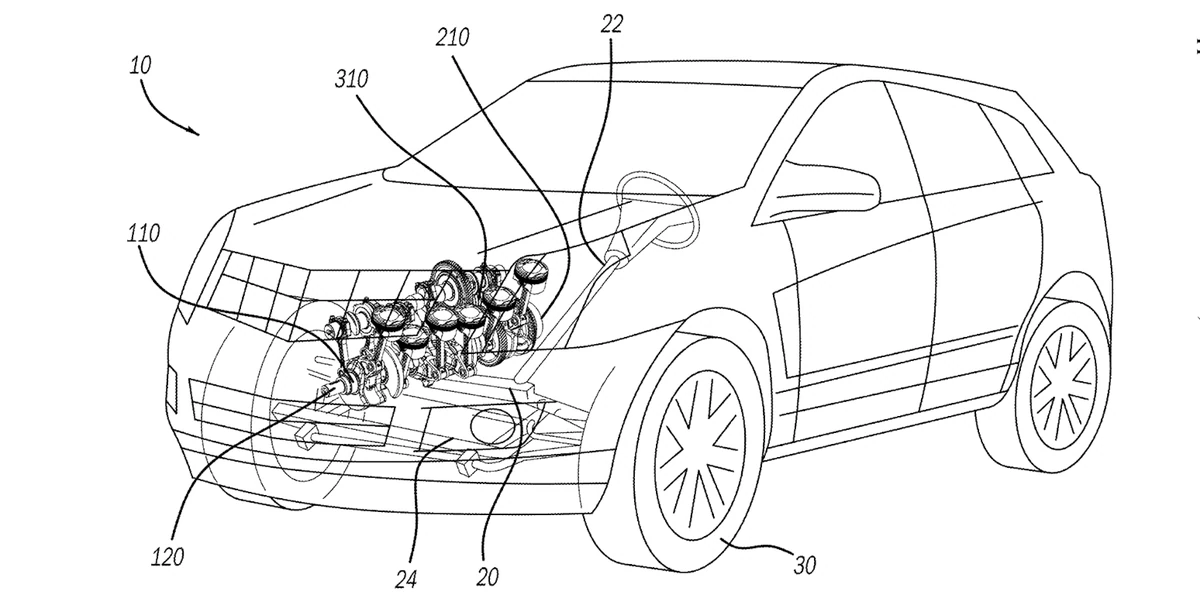
The new application would swap that centre link for a two-piece assembly assembled around the crankshaft, with one part connecting to the piston rod and the other to the control rod. The bolts joining the two halves would be reachable from below the engine, likely with the oil pan removed. GM also says the design would allow conventional lubrication of the connecting rods, which together with the two-piece link could make the engine easier to service and less prone to bearing-related problems.
That matters because service access is one of the practical hurdles for variable-compression hardware. An engine that needs specialist attention deep inside its bottom end is a harder sell to fleets and high-mileage truck buyers than one a technician can strip from underneath.
Why the control shaft sits above the crankshaft
GM's design places the control shaft above the crankshaft, which the filing says frees space below a longitudinally mounted engine for engine mounts or for the vehicle's steering or four-wheel-drive equipment. That packaging question is central to longitudinal applications, where the engine sits front-to-back and the space underneath is contested by driveline and chassis parts.
GM's arrangement would also let the expansion stroke run longer than the compression stroke, by up to 40 percent, which carries potential efficiency benefits. Nissan's VC-Turbo, already on sale, achieves its Atkinson-cycle effect through valve timing instead, and it is designed for transverse front- and all-wheel-drive applications. Honda has commercialised a comparable extended-expansion concept called EXlink in household cogeneration units that supply electricity and hot water.
What the drawings show, and what they do not
The patent drawings depict a petrol inline-six, a layout GM does not currently use, but the filing is not evidence that such an engine is planned. The same concept could be applied to engines such as the L3B 2.7-litre four-cylinder, the unit with sliding cam sleeves used in Chevrolet and GMC half-ton trucks, which could also find its way into a new Camaro or Buick sedan.
GM's record supports reading the filing as more than paperwork: the company has brought its own versions of cylinder deactivation and sliding camshafts to production, and is currently enlarging and boosting its truck V-8s without entirely sacrificing efficiency. Variable compression would be the next fuel-saving technology to move from that pipeline into a wider range of engines, if the patent work translates into hardware.
The catch for buyers
A patent application is not a product announcement. No timeline, no confirmed engine family and no vehicle has been named, so drivers should treat the serviceability claim as an engineering intention rather than a specification. The detail worth watching is the two-piece link: if it reaches production, routine work on a variable-compression engine could look much like work on a conventional one, which is the difference between a niche technology and one that can be sold across a truck range.