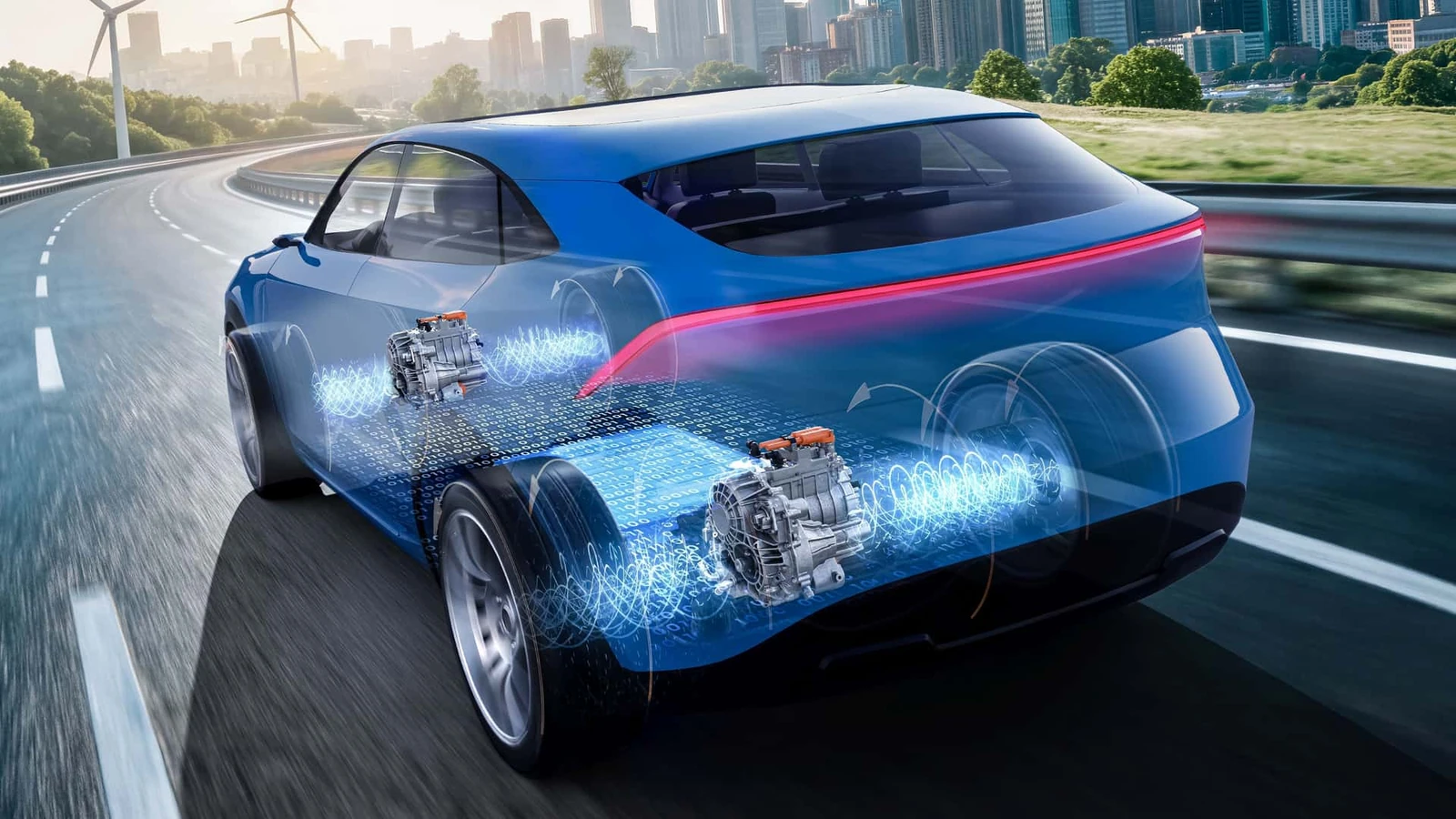
ZF has revealed a new integrated electric drive unit that spins to 30,000 rpm, pitched not at supercars but at the mainstream electric cars ordinary buyers drive. The German supplier says the High Revolution Drive targets production by 2030, though it has not yet named a single vehicle that will use it.
The unit packages motor, power electronics and transmission in a single housing. Against one of ZF's comparable Select drive units, which spins to 18,000 rpm, the company claims nearly 25% less weight and volume, half the magnet mass and efficiency of almost 93%.
How the high-rev approach works
ZF's logic is that spinning the motor faster lets it produce the same power from a smaller, lighter package. A reduction ratio of roughly 18:1 then brings that speed down and multiplies turning force to the wheels.
The version ZF showed produces up to 268 horsepower, with the gearing delivering peak torque of 2,581 pound-feet (3,500 Nm) at the wheels. That torque figure is measured after the gearing has multiplied the motor's output, so it is not a direct read of the motor itself.
The "two-stage transmission" label describes successive gear reductions rather than a two-speed gearbox with two separate driving ratios. ZF says the production High Revolution Drive should deliver 200 to 268 hp and work with both 400- and 800-volt platforms.
Why magnets and mass matter
Cutting magnet content is about more than cost. Fewer magnets reduce dependence on a constrained supply chain, while lower mass helps range, which is why suppliers are pushing in this direction for volume models rather than halo cars.
Reusing ZF's modular Select architecture should simplify installation, shorten development time, control costs and preserve manufacturing flexibility. ZF says talks with automakers are underway.
The comparison with Yasa shows how carefully these claims need to be read. One prototype of Yasa's ultra-compact axial-flux motor produced over 1,000 hp and weighed just 28 pounds, with continuous output estimated at 469 to 536 bhp. That figure covers the motor alone, whereas ZF's weight reduction applies to the whole integrated drive unit, and gearing and power electronics still have to live somewhere and add weight.
Repair kits and the questions left open
ZF has also introduced repair kits intended to let workshops fix individual drive unit components, such as gearbox bearings, instead of replacing entire assemblies. That addresses a different problem from shrinking hardware, but one owners may care about more once a warranty expires.
ZF has not said whether the two developments are connected, or whether the repair kits amount to a repairability promise for this new drive.
The bigger gaps are commercial. No production EV has been named for the unit, and ZF has not said whether the engineering gains announced today will hold unchanged in the version that reaches showrooms.
Whether the weight and cost savings reach buyers has not been announced either. ZF's claims concern the drive unit as supplied to automakers, and the company has not said how much of that saving, if any, would show up in showroom prices or in the range figures buyers see. The savings are a starting point, not a promise at the till.
A quieter kind of EV progress
This is the unglamorous end of EV development, and it matters more than a four-figure horsepower headline for most drivers. A family car does not need to break acceleration records, but a lighter, cheaper drive unit is exactly the sort of hardware improvement that could make everyday electric cars more affordable and more efficient.
The catch is timing. With production targeted for 2030 and no confirmed customer, the High Revolution Drive is a signal of where mainstream EV hardware is heading rather than something a buyer can order now.