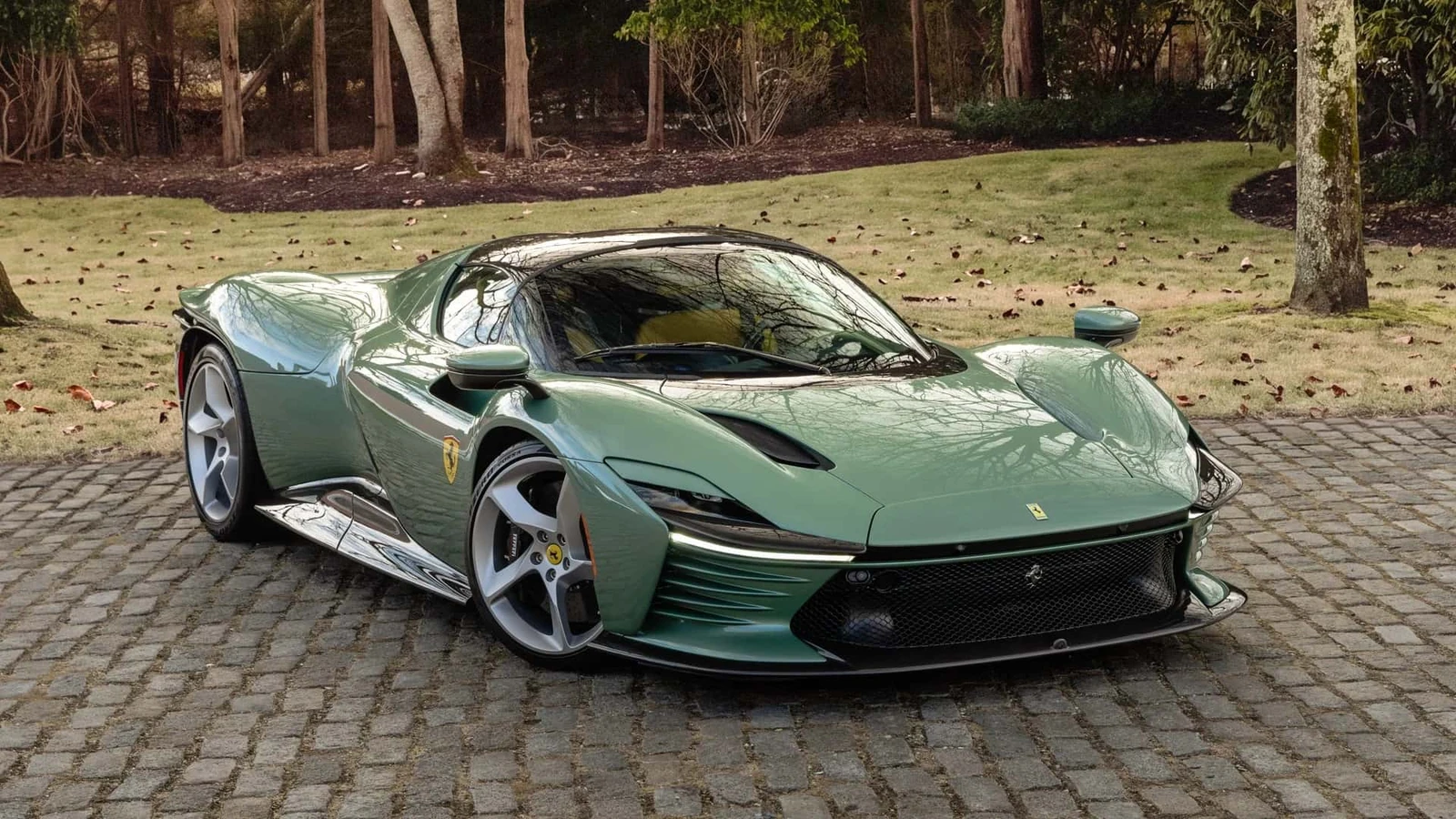
Two Ferrari Daytona SP3s changed hands on the same day for wildly different sums, with a green car selling for $18.54 million at Broad Arrow's Las Vegas auction and a yellow one fetching $10.9 million through RM Sotheby's in London.
The $7.6 million gap between two examples of the same limited-run V12 supercar comes down largely to condition and mileage, according to Hagerty's assessment cited in coverage of the sales.
What separates the two cars
The green SP3, finished in Verde Francesca, shows just 81 miles on its odometer, while the yellow car has covered 2,948 miles and reportedly served as a Ferrari press vehicle at one point.
Hagerty's read is that the US market is far more willing to pay a premium for rare, low-mileage supercars, which helps explain why the American sale outstripped the London result.
Beyond the colour combination and the exceptionally low mileage, there is nothing else that sets the green car apart, which makes the hammer price a striking outlier even by Ferrari standards.
The $18.54 million figure is the highest recorded for an SP3 apart from a single car that brought $26 million at a charity auction.
The hardware underneath
Both cars carry the same mechanical package: a naturally aspirated V12 with no turbochargers and no electrification, rated at 829 horsepower and revving beyond 9,000 rpm.
The Daytona SP3's design draws on Ferrari's historic race cars, which is central to its appeal among collectors.
That specification is fixed across the model, so the auction results say more about how these cars are kept and driven than about any difference between them.
A market that rewards not driving
The green car's near-delivery mileage implies a life spent in climate-controlled storage rather than on the road, and it will likely continue to move between owners inside a car carrier or the hold of a cargo jet rather than under its own power.
The yellow car's 2,948 miles, by contrast, mark it as one that has actually been used, and the market priced that history accordingly.
For buyers watching supercar values, the takeaway is blunt: on limited-run models, mileage and originality of specification carry more weight than the driving experience itself. The gap between the two results is a premium paid for a car that has barely been driven, not for anything mechanical.