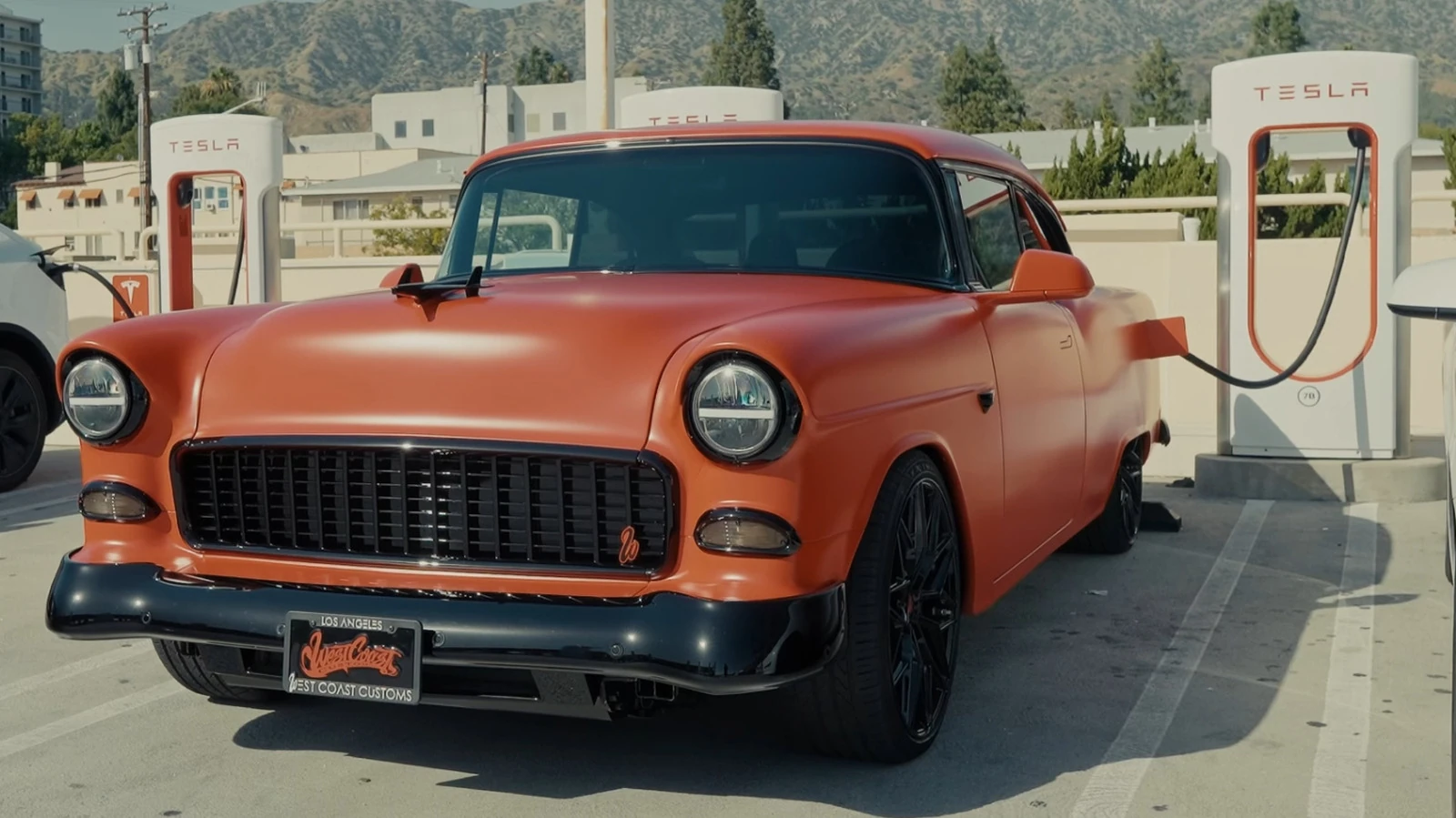
West Coast Customs has married a classic Chevrolet Bel Air body to the chassis and electric powertrain of a Tesla Model 3, creating a restomod that charges at Tesla Superchargers. The build was commissioned by an owner who wanted to convert his cars, muscle cars included, to electric power, and he supplied both the Bel Air and a grey Model 3 for the job.
How the two cars were combined
The shop began by stripping the Model 3 and cutting off its body, leaving the skateboard-style platform that carries the battery and drivetrain. The Bel Air's body was then lifted off and transplanted onto that chassis. Because the two cars have different wheelbases, among other mismatches, the Bel Air needed significant modification to fit; West Coast Customs stretched the rear wheel well and eventually reached a point where the body mated to the Tesla architecture surprisingly well.
The cabin treatment follows the same logic. Most of the Model 3's interior was retained, cut out carefully alongside the chassis, so the steering wheel, seats and infotainment screen carry over. The dashboard required a range of modifications to make everything function as intended. West Coast Customs finished the inside with hexagon stitching on the retrimmed seats, a nod to current Lamborghini interiors.
What marks it out as electric
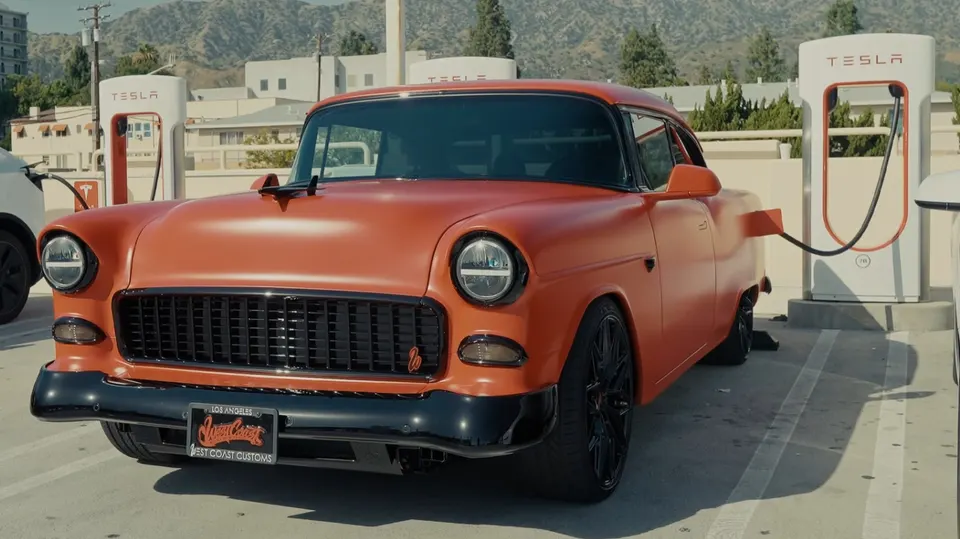
The exterior is unmistakably a Bel Air rather than a Tesla, repainted in matte red with black accents on the grille, bumpers, headlights and taillights. The giveaway is a small, discreet charging flap that lets the car plug into a Tesla Supercharger.
That flap is the practical payoff of the whole exercise. Keeping the Model 3's charging hardware means the finished car uses Tesla's own network rather than an adapter or a third-party setup, which is the part of this build most likely to matter day to day. The rest is craftsmanship: matching two bodies with different dimensions is the hard part, and stretching the rear wheel well was the workaround that made it possible.
What has not been announced
The sources do not give range, power or torque figures for the finished car, and no price for the conversion has been disclosed. Because the Model 3 donor was a standard grey car, the outputs would follow whichever version it was, but that variant is not specified.
For buyers weighing a similar conversion, the appeal is a classic silhouette with modern charging access and a Tesla-sourced interior. The trade-off is that the car is no longer a numbers-matched classic underneath: its wheelbase, cabin and dashboard are all adapted Tesla hardware, which matters to anyone judging it as a Bel Air rather than as an electric car.