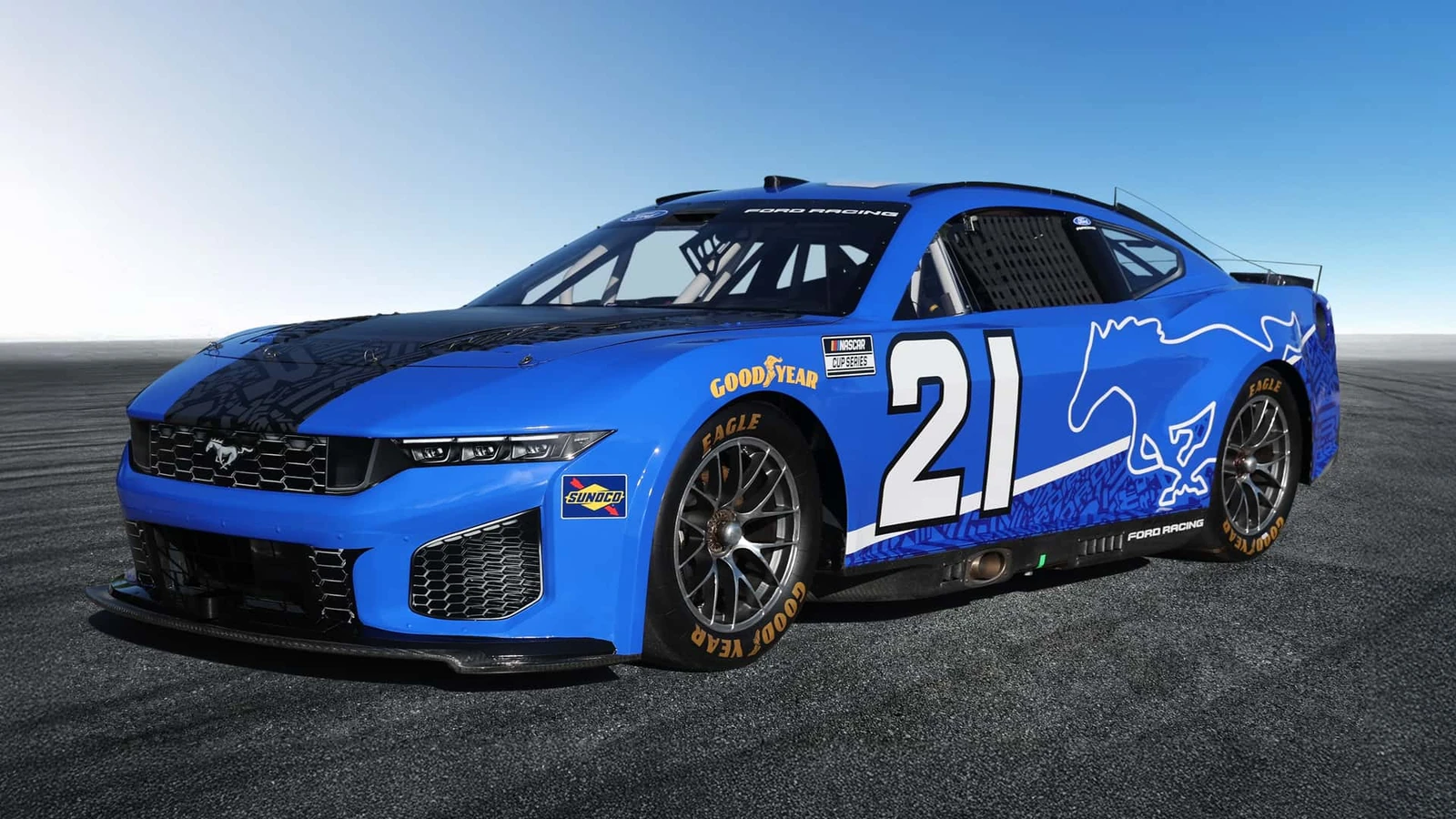
Ford revealed its 2027 NASCAR Cup Series Mustang on November 11, and the car's most distinctive feature is a nose lifted from the road-going Mustang Dark Horse SC. The reveal took place at the Motorsports Hall of Fame of America during the inaugural Proud to Honor Veterans Day Classic, held at Daytona.
Team Penske, RFK Racing and Front Row Motorsports will all field the new body from next season, with its competition debut set for Daytona Speedweeks and the 69th running of the Daytona 500 on February 21, 2027.
What Ford changed on the Cup car
The front fascia is the headline change, translating the Dark Horse SC's face almost directly rather than sanding it into a generic shape. NASCAR describes the design as optimising aerodynamics, pairing increased cooling on the road car with more downforce for the race car.
Mark Rushbrook, global director of Ford Racing, framed the project as a two-way street: "Racing makes our road cars better, and our road cars make our race cars better".
Ford has not published power or aerodynamic figures for the Cup car itself. That is not an oversight. NASCAR caps total downforce, drag and engine output, so every team works inside a fixed rules box regardless of what the street car produces. The Dark Horse SC's supercharged 5.2-litre V8, rated at 795 hp and 660 lb-ft of torque in production form, is the template rather than a spec sheet for the racer.
Why a road-car nose matters in a spec-body series
NASCAR's Cup Series has run spec bodies for years, leaving manufacturers to differentiate themselves mainly through nose and tail details. A front end this closely tied to a showroom model gives Ford a sharper identity on track than a generic template would, and it ties the race programme to a car buyers can actually order.
The trade-off is that the resemblance carries marketing weight rather than performance weight. Because the rules box fixes the aerodynamic and power ceilings, the Dark Horse SC nose signals Ford's design language to the grandstands more than it promises an on-track advantage.
The Veterans Day setting behind the reveal
Ford chose the Proud to Honor Veterans Day Classic over a conventional media event, and the support race format explains why. The inaugural race placed 12 Ford Racing drivers in Mustang Dark Horse R cars across six two-driver teams, one for each US military branch.
Proceeds from the event support military members, veterans and their families. The Dark Horse R entries gave the Classic its own competition separate from the Cup reveal, running the same production-based Mustang lineage a step below Cup machinery.
Ford has used the Dark Horse badge across several programmes this year, including GT3 cars that recreated a 1901 sweepstakes livery for a separate anniversary tie-in. The Cup car's first real test against the field comes at the Daytona 500 on February 21, 2027, which closes out the opening stretch of the season.