Volkswagen has applied to register the name ID. UP with the European Union Intellectual Property Office, a filing dated October 22, 2026 that points to the badge its long-promised sub-€20,000 electric city car could wear. The car itself, currently referred to as the ID.1, is already being built in pre-series form at the company's Autoeuropa plant in Palmela, Portugal, ahead of regular production planned for the fourth quarter of 2027.
The trademark is a signal of intent rather than a decision. A filing protects a name; it does not confirm the name will reach the boot lid, and Volkswagen has said nothing about final pricing, range or badge until it confirms those details closer to the production date.
What the EUIPO filing does and does not settle
Volkswagen's application to the EUIPO was lodged on October 22, 2026. The ID. prefix is already established across the brand's electric range, and the UP element reaches back to the petrol-powered Up city car.
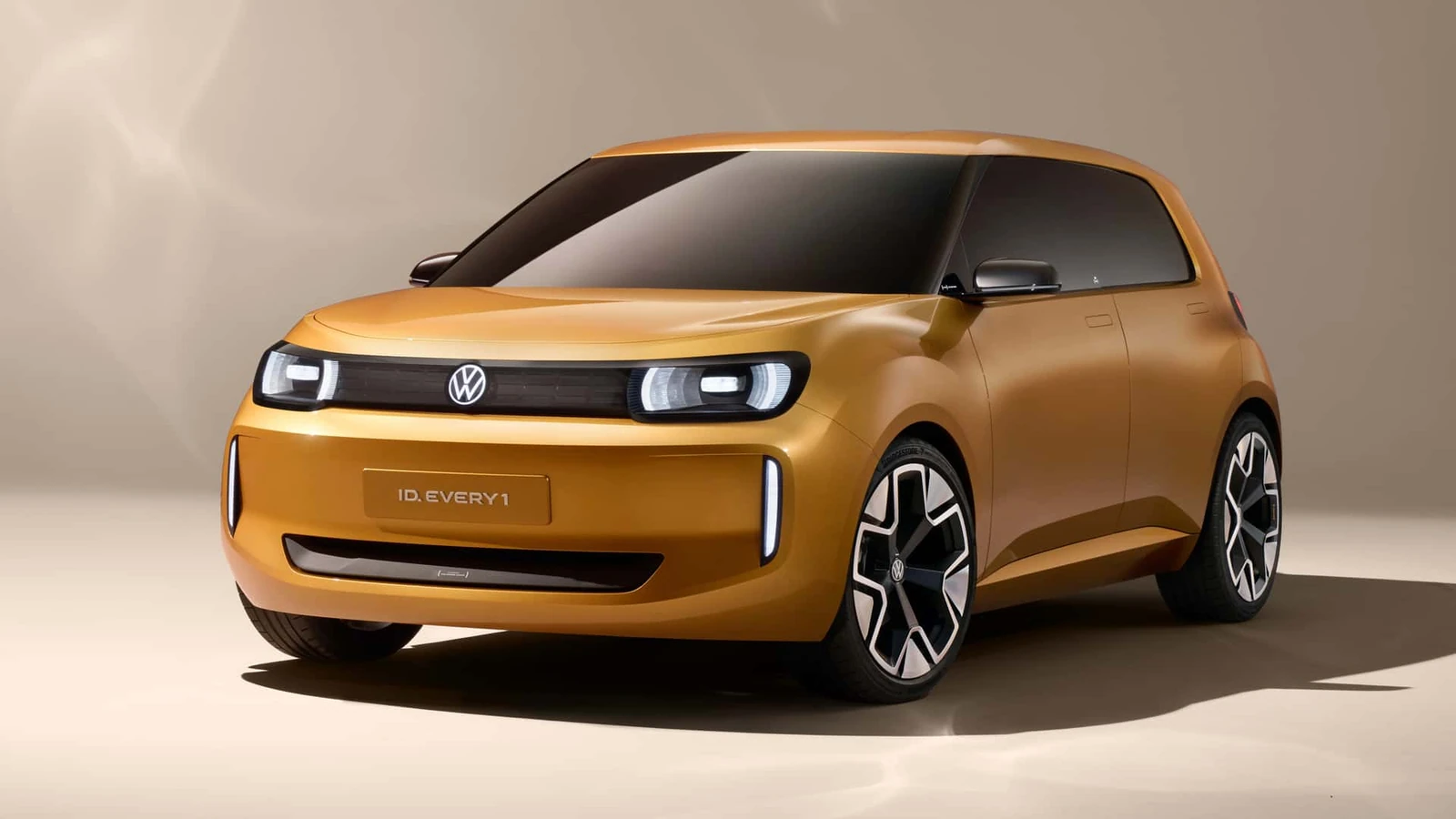
That combination makes ID. UP a plausible fit for the entry-level model previewed by the ID. EVERY1 concept, but the filing alone does not lock it in. The pre-production cars now running in Portugal are still being called ID.1.
Palmela pre-series build and the 2027 timeline
Volkswagen built the first ID.1 pre-production units at Autoeuropa in Palmela, using them to test tools, assembly methods, work steps and cycle times on the line, according to Volkswagen Group as reported by Electrek. The cars reportedly came off the line clean and the plant met the targets set for this stage of testing.
Regular series production is scheduled for the fourth quarter of 2027 at Palmela. The plant is set to share the ID.1's assembly line with the T-Roc, and Autoeuropa already runs three shifts with capacity for up to 1,000 vehicles a day, a figure the T-Roc has so far carried alone.
Anabel Andión Lomero, the plant's new general manager, told Portuguese outlet Razão Automóvel that Autoeuropa can adjust the production split between the T-Roc and the new EV according to demand once both are at full regular output. The plant built 240,400 cars in 2025, its second-best year on record, with the T-Roc accounting for that volume.
Volkswagen chief executive Thomas Schäfer has cited the plant's efficiency as the reason Palmela was chosen to build the group's cheapest EV, a decision the company has linked directly to the sub-€20,000 target. Group management has described the choice of plant as decisive in reaching that price.
Concept-derived targets and the Rivian connection
Early figures based on the ID. EVERY1 concept describe a car around 3,880 millimetres long, sitting between the old Up at 3,600 millimetres and the ID. Polo at 4,050 millimetres. The concept carries a 37 kWh LFP battery, a 70 kW motor, a minimum range target of roughly 250 kilometres and a 305-litre trunk.
Volkswagen has not confirmed final production specifications and has not published usable battery capacity or peak charging power. The range figure is a target tied to the concept rather than a certified result on a WLTP, EPA or any other test cycle, so it should not be read as a homologated number.
The ID.1 is set to be the first Volkswagen Group series model built on electronics and software architecture co-developed with Rivian. That architecture consolidates vehicle functions into fewer control units and supports adding features after delivery through over-the-air updates.
The positioning puts the car against the Dacia Spring and Citroën ë-C3, and the Palmela cost base is what gives Volkswagen room to price it in that fight. For buyers, the significance is less about the badge than about whether a European-built EV can undercut those rivals without the compromises usually attached to the cheapest electric hatchbacks.
What is still open
Volkswagen has used ID. naming on larger electric SUVs including the ID. Tiguan, and the separate ID. Cross remains a near-production compact B-segment SUV concept previewing a future addition to the family.
Final pricing, range and the production badge all remain unconfirmed until Volkswagen announces them nearer the fourth quarter of 2027. The ID. UP filing is the clearest hint yet of the name, but it is a hint, not a specification sheet.