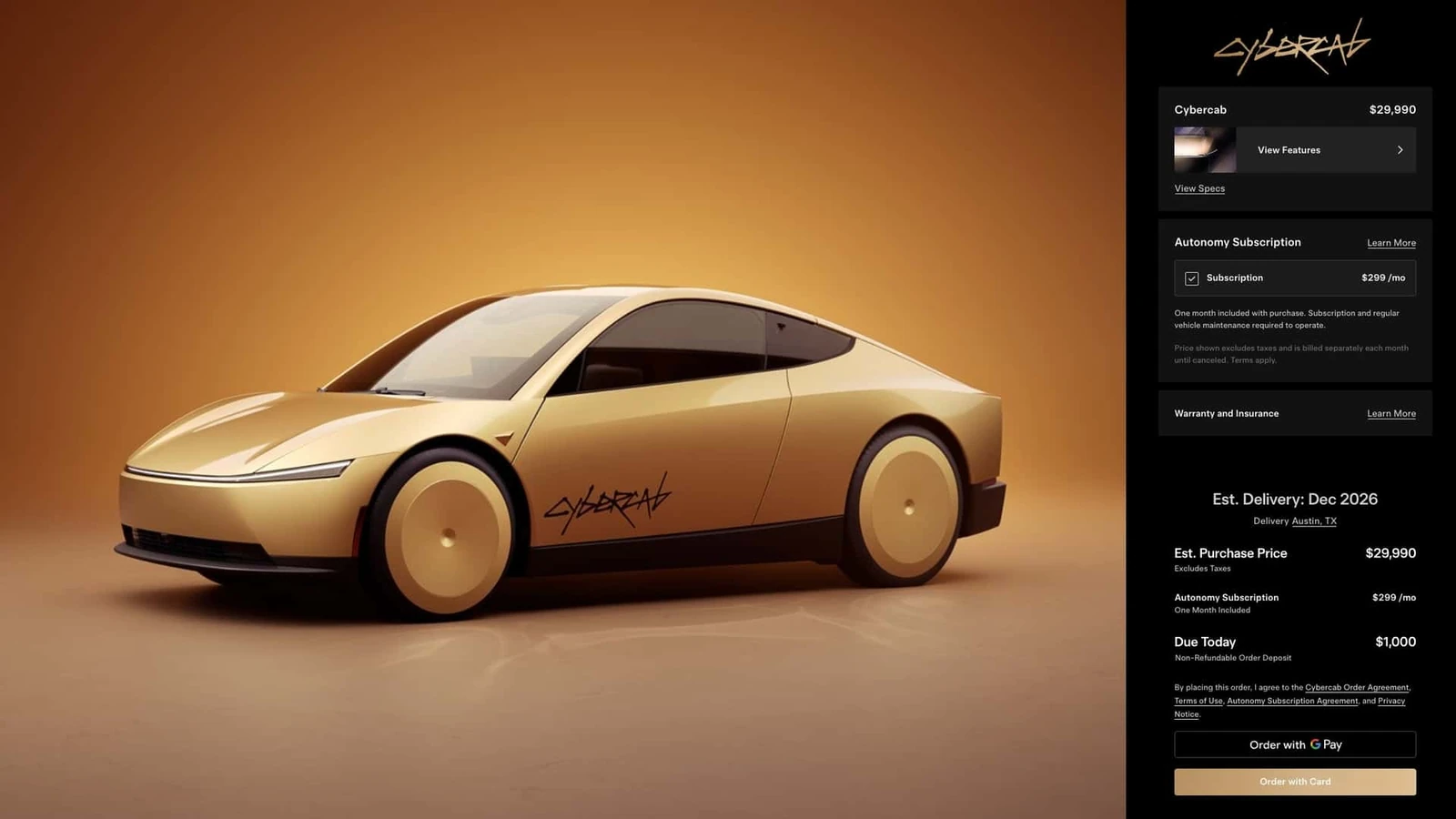
Tesla has opened the Cybercab to private buyers at $29,990 before taxes, with deliveries due to begin in December 2026 starting in Austin. The order page sets out conditions that go well beyond the sticker price: a $1,000 non-refundable deposit to lock in a build slot, and a mandatory $299 monthly Autonomy Subscription for the car to operate.
Tesla's email to invited buyers stated the limits directly: "Only available in supported service areas. Subscription required for operation". The first month of the subscription is included in the purchase, and Tesla says the terms allow it to suspend autonomous driving features if the agreement is violated.
What the subscription and deposit commit buyers to
The deposit is non-refundable, so reserving a build slot is a committed purchase rather than a refundable hold. The Autonomy Subscription is not an optional extra: without it, the car does not run.
Run the numbers and a Cybercab costs roughly $65,600 over its first ten years, assuming the $299 monthly fee and today's vehicle price hold roughly steady across that period and factoring in the included first month. That figure is a projection from the published terms rather than a Tesla announcement, and it excludes taxes and any change in pricing or fees over the decade.
Tesla plans to sell Cybercabs through the end of 2026, with the Austin plant handling early builds before other markets come online. The car is described as a purpose-built autonomous vehicle with no steering wheel or pedals in its normal setup.
Two seats, a 21-inch screen and eight cities
Inside, buyers get two seats, a 21-inch centre touchscreen and 20.1 cubic feet of cargo room, figures Tesla first published when it detailed the Cybercab's specs.
Operation is confined to geofenced Robotaxi service areas. Tesla lists eight supported cities: Austin, Dallas, Houston, Fort Worth and San Antonio in Texas, plus Miami, Orlando and Tampa in Florida. The terms say the zones are limited and can change over time.
Coverage inside those cities may be narrower than Tesla's wider marketing maps suggest, which can limit how far a Cybercab travels on its own in daily use, particularly on trips that stretch toward the edge of a service area. For a buyer, that makes the practical question less about the car's capability than about whether their regular journeys fall inside the fence.
Federal scrutiny of a car without pedals
The sales launch arrives with the Robotaxi programme already under federal attention. The National Highway Traffic Safety Administration has opened an Audit Query into Tesla's certification that the Cybercab meets all Federal Motor Vehicle Safety Standards. The agency is examining the technical data behind the car's missing manual controls, including how a vehicle certified without a traditional foot pedal and steering wheel fits rules that typically assume those parts are present.
The programme has also drawn scrutiny tied to a hidden joystick control, which raised questions about how hands-off the rides actually are. Neither matter is resolved by the order page, and Tesla has not said how either will affect deliveries.
What buyers still cannot see
Tesla has not announced pricing or availability for markets beyond the United States, and the eight-city service list is the only operating territory named so far. The order page also leaves the long-term subscription price open: the ten-year cost estimate only holds if the $299 monthly fee stays roughly steady.