Mercedes-Benz will launch its Hands-Free Highway Assist and MB.Drive Assist Pro driver-assistance systems in December 2026, starting with a limited number of customers in California before a nationwide rollout in 2027. Both systems will reach compatible vehicles through an over-the-air update, and Mercedes intends to sell them as subscription services after a short trial period.
What each system does
MB.Drive Assist Pro allows equipped cars to accelerate, brake, steer and respond to traffic lights, road signs, other vehicles and pedestrians. Hands-Free Highway Assist, as the name suggests, lets drivers take their hands off the wheel on the highway, and it can perform automatic lane changes, including guiding the car to a navigation destination or exit.
Mercedes is direct about the limits of both systems and does not hide the active role the driver still plays when either is engaged. In practice, MB.Drive Assist Pro still requires a hand on the wheel, while Hands-Free Highway Assist is reserved for highway driving.
Which Mercedes models are eligible
For 2027, models able to support both systems include the CLA-class in petrol and electric form, the GLC-class Electric, GLE-class, GLS-class, S-class, and 2026 CLA-class Electric models fitted with the brand's MB.Drive Assist suite.
Hands-Free Highway Assist alone will be offered on the 2027 GLB-class, C-class, petrol-powered GLC-class and AMG GT 4-Doors with MB.Drive Assist. New versions of compatible models will be able to leave the dealership with one or both features active.
How the systems behaved in San Francisco
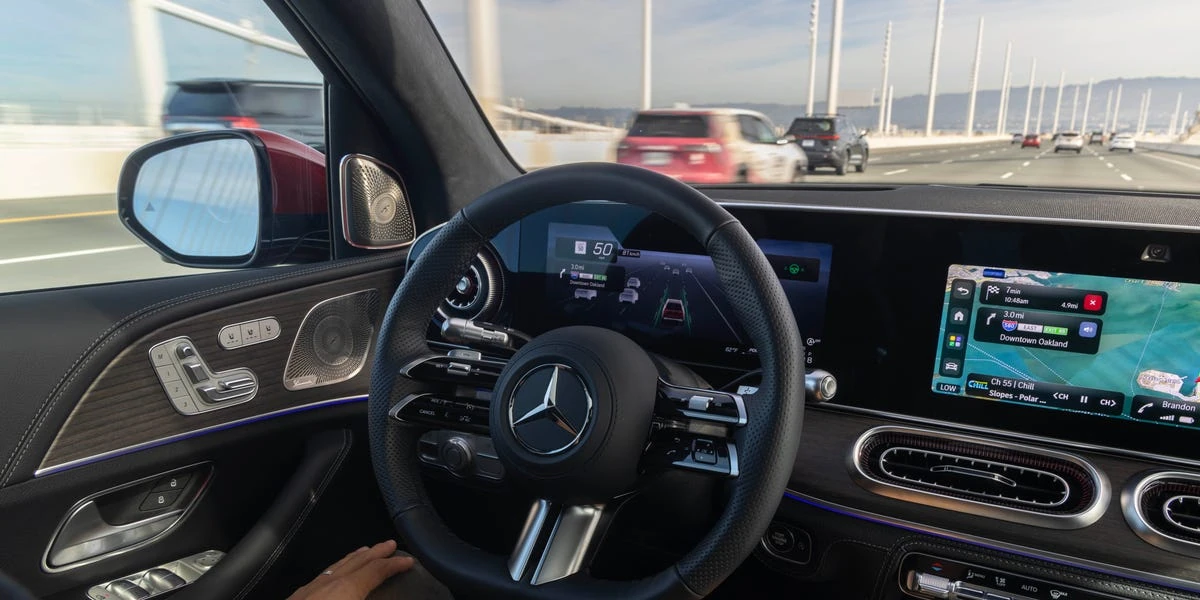
Car and Driver tested both systems in California's Bay Area, driving MB.Drive Assist Pro in an all-wheel-drive GLC400 Electric through north San Francisco and Hands-Free Highway Assist in a plug-in hybrid S550e across the San Francisco-Oakland Bay Bridge.
In dense city traffic, MB.Drive Assist Pro drove smoothly but cautiously. After stopping correctly at a red light beside a busy crosswalk, it crept forward slowly once the light turned green and braked again when it detected movement from pedestrians at either end of the crosswalk, apparently reading their motion as an intent to cross; getting through the intersection took a brief push of the accelerator. A similar override was needed a few minutes later, when the system steered around a truck in its lane, spotted a stop sign and stopped before fully returning to its lane.
On the highway, Hands-Free Highway Assist handled automatic lane changes calmly, with or without the driver's hands on the wheel, and followed a navigation route toward an exit. It did, however, miss the red light at a toll area, and it asked for driver input on mildly curving stretches of highway, which the test found to be its most irritating trait. Mercedes can refine both systems over time through its partnership with Nvidia, using real-world driving data to improve performance and deliver updates over the air.
Subscription details and timing
Mercedes has not disclosed what the subscription will cost or how long the trial period will last. The company has only said the systems will be offered as subscriptions following a brief trial, and comparable systems from rivals have run from a few years to as little as a month.
The December 2026 start applies to a limited set of California customers with select models running the brand's MB.OS software, delivered by over-the-air update. The wider US rollout follows in 2027, again by over-the-air update, for current owners of compatible cars.
The staggered approach is deliberate. Mercedes took close to six years to field a rival to Tesla's point-to-point automated driving system, and the California-first, subscription-based rollout reflects a preference for steady deployment over rapid, wide release. For buyers, the practical question is less whether the hardware exists than what access will cost once the trial ends, and on that Mercedes has so far said nothing.