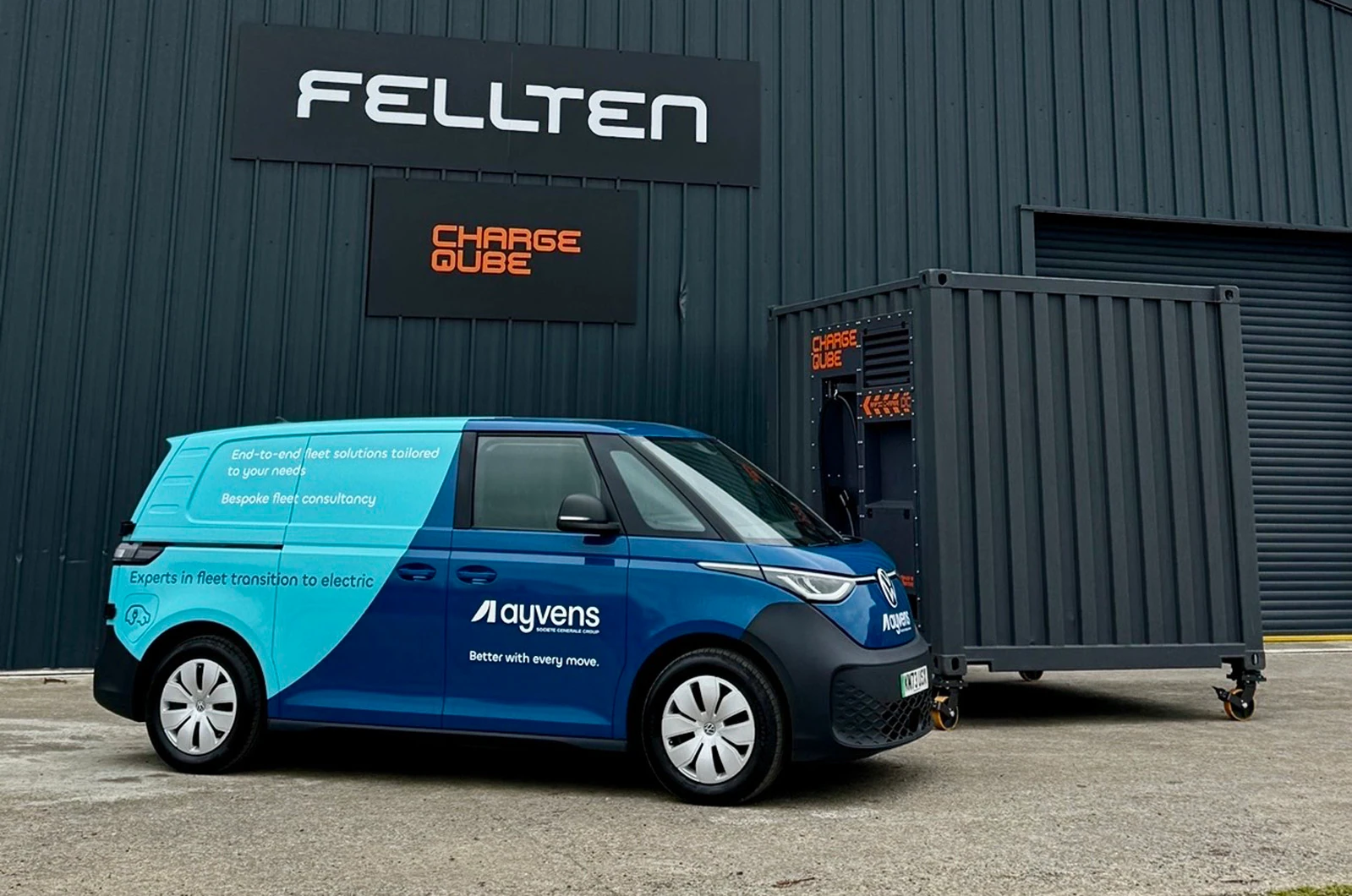
Fleet company Ayvens and electric vehicle technology firm Fellten have partnered to supply containerised EV chargers to company car fleets, aiming to sidestep long grid upgrade queues and cut drivers' reliance on public charging networks.
The units, called Charge Qubes, combine AC or DC charging with a battery pack holding up to 1MWh of storage in a single container. Ayvens and Fellten say they will work with customers to identify pinch points in charging demand, using fleet telematics data where available, and deploy the Qubes where a site lacks the power to meet that demand.
How the Charge Qube units work
Fellten's Charge Qubes need no groundwork and plug into a three-phase supply, which means they can be deployed within two hours if a connection is already available, and relocated if needed, though they are also designed as a permanent solution.
Ayvens's head of customer data and innovation, Russ Boulton, said the Qubes let fleets draw far lower peak power than a DC charger, so they can buy energy when it is cheapest and greenest and dispense it when drivers need it, savings that could be passed on to company car drivers.
Fellten sales and marketing director Simon Tate said the biggest challenge for fleets is not the vehicles themselves but the infrastructure needed to keep them moving, and that the Qube challenges the idea that businesses must wait for expensive grid upgrades before electrifying.
Why fleets are looking past the grid
Data centres, EV charging and industry have put pressure on grid installation upgrades, and a recent government release claimed demand rose 460% in the first half of 2025, with projects now taking up to 15 years to complete.
For EV fleets, that leaves drivers relying on public charging that can be 13 times more expensive than the cheapest home energy rates.
Boulton said the need is growing as fleets increasingly restrict company car choice lists to plug-in hybrid and electric cars, and face pushback from drivers who have to rely on public networks.
He described the resulting gap within fleets, where some drivers pay around 1.7 pence per mile while others pay 30 or 40 pence per mile and do not feel the benefit, adding that fair, well-priced workplace charging is a real help with the transition.
The pitch is aimed squarely at the cost gap between drivers who can plug in at home and those who cannot. Charging that follows the driver rather than the depot is the practical answer for fleets that have already committed to electrification but cannot get the power they need.
What has not been announced
Neither company has confirmed pricing for the Charge Qubes, how many units are being built, or which customers will receive the first installations. Ayvens and Fellten have also not said which markets the partnership will cover initially.