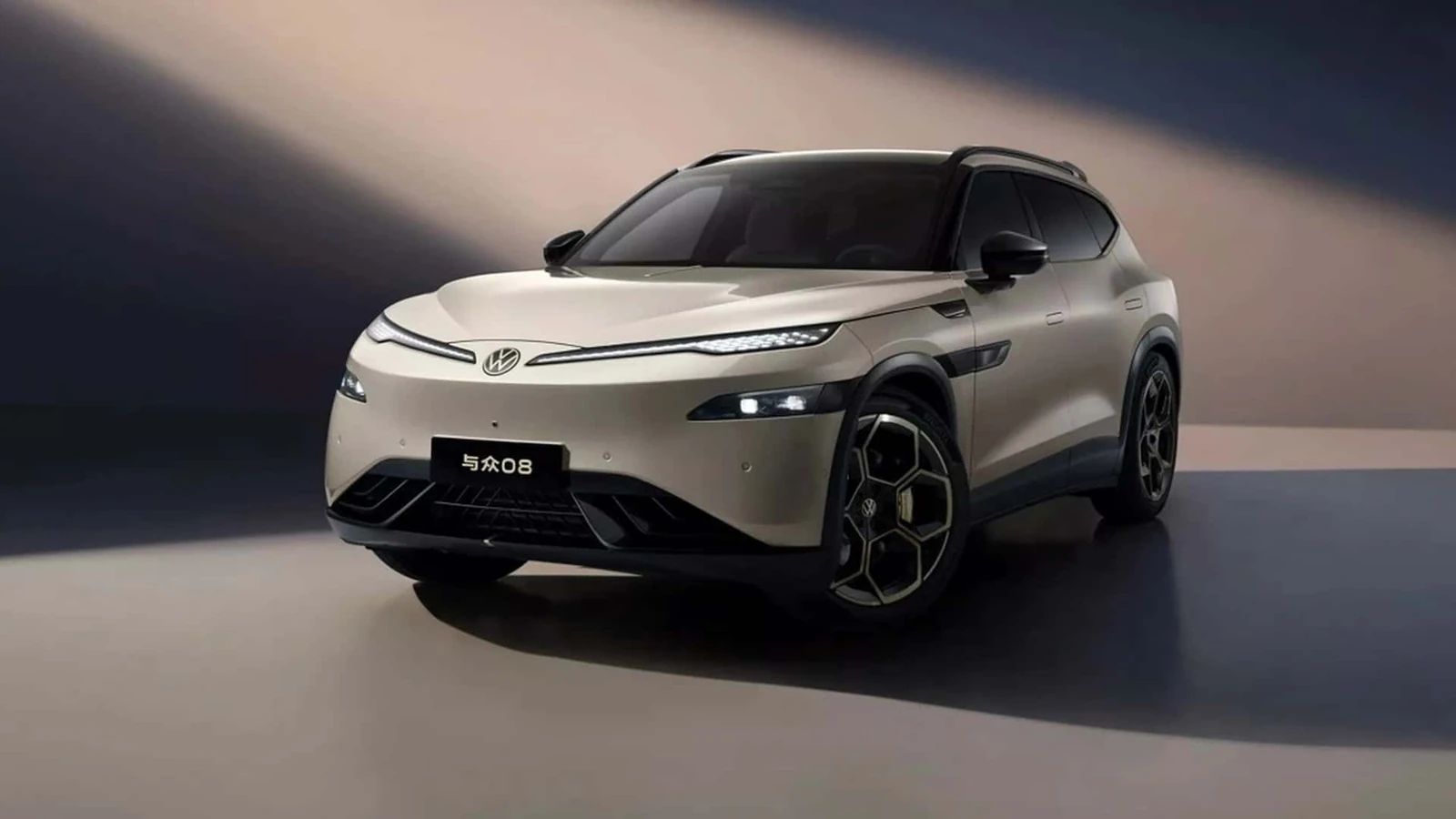
Volkswagen's first car co-developed with Xpeng, the ID. Unyx 08, is selling at roughly 267 units a month in China, a fraction of the pace the company had planned. The midsize electric crossover has been on sale since April and is built at Volkswagen's Anhui plant.
Internal company documents seen by Reuters set an original target of about 3,622 units per month, and Volkswagen did not comment on those goals when the outlet contacted it. The figures, drawn from ThinkerCar data cited by Reuters and covering sales through August, land as VW tries to rebuild a China business that once sold a record 4.2 million vehicles a year there.
A G9 under the skin, priced against Xiaomi and Zeekr
The ID. Unyx 08 shares much of its mechanical basis with the Xpeng G9 and competes in China's premium crossover segment. Pricing starts at around $35,000, which reads as a bargain in Western terms but is ordinary for the Chinese market.
Its two closest rivals, the Xiaomi YU7 and Zeekr 7X, are slightly cheaper and easier to buy. The Xiaomi brings an advanced sensor package and tight integration with the company's consumer electronics, while the Zeekr 7X stands out for strong DC fast charging speeds.
Distribution may be doing as much damage as the product. The ID. Unyx is retailed only through dedicated Volkswagen ID. Unyx dealerships, whereas Xiaomi and Zeekr models sit in accessible stores found in nearly every higher-end mall in China. Volkswagen is working to expand its ID. Unyx dealer network, and it has cut the ID. Unyx 08's price to about $28,500.
Pedro Pacheco, vice president of research at Gartner, framed the problem for Reuters bluntly: Chinese customers ask why they should buy an expensive German car when they can get the technology much cheaper. That is the heart of it. Building a car quickly and cheaply gets a brand onto the market, but it does not make the car desirable next to local rivals that bundle software and charging advantages the ID. Unyx does not match.
The next Xpeng-based model has a bigger target
Volkswagen is pressing on with the Xpeng tie-up, which covers platform and software development and mirrors its Rivian partnership in the United States. The next model from the collaboration, the ID. Unyx 09 sedan, carries an even more aggressive internal goal of 4,900 units per month.
Whether the ID. Unyx models will be sold outside China has not been announced. Volkswagen is considering selling the Xpeng-based ID. Unyx cars in markets beyond China, but no export timetable, destination markets or pricing have been confirmed.
The stakes are visible in the numbers. Volkswagen Group's China sales fell from a record 4.2 million in 2019 to 2.69 million last year, as Chinese buyers moved en masse to EVs from homegrown brands. The ID. Unyx 08 was meant to be part of the answer, and at roughly 267 units a month it is not yet one.
Toyota shows the joint-venture route can work
The strategy itself is not doomed. Toyota's partnership with GAC has produced BZ models using GAC mechanicals and software, and the BZ3X crossover, which shares much of its design with the GAC Aion V, became China's best-selling joint-venture EV earlier this year with a record 10,000 sales in April alone.
The difference is execution rather than concept. Toyota's joint-venture EV found a price and a product mix Chinese buyers wanted. Volkswagen has the speed of development that the Xpeng deal bought it, but the ID. Unyx 08 suggests speed alone does not move metal when the competition is cheaper, better connected and easier to find in a showroom.