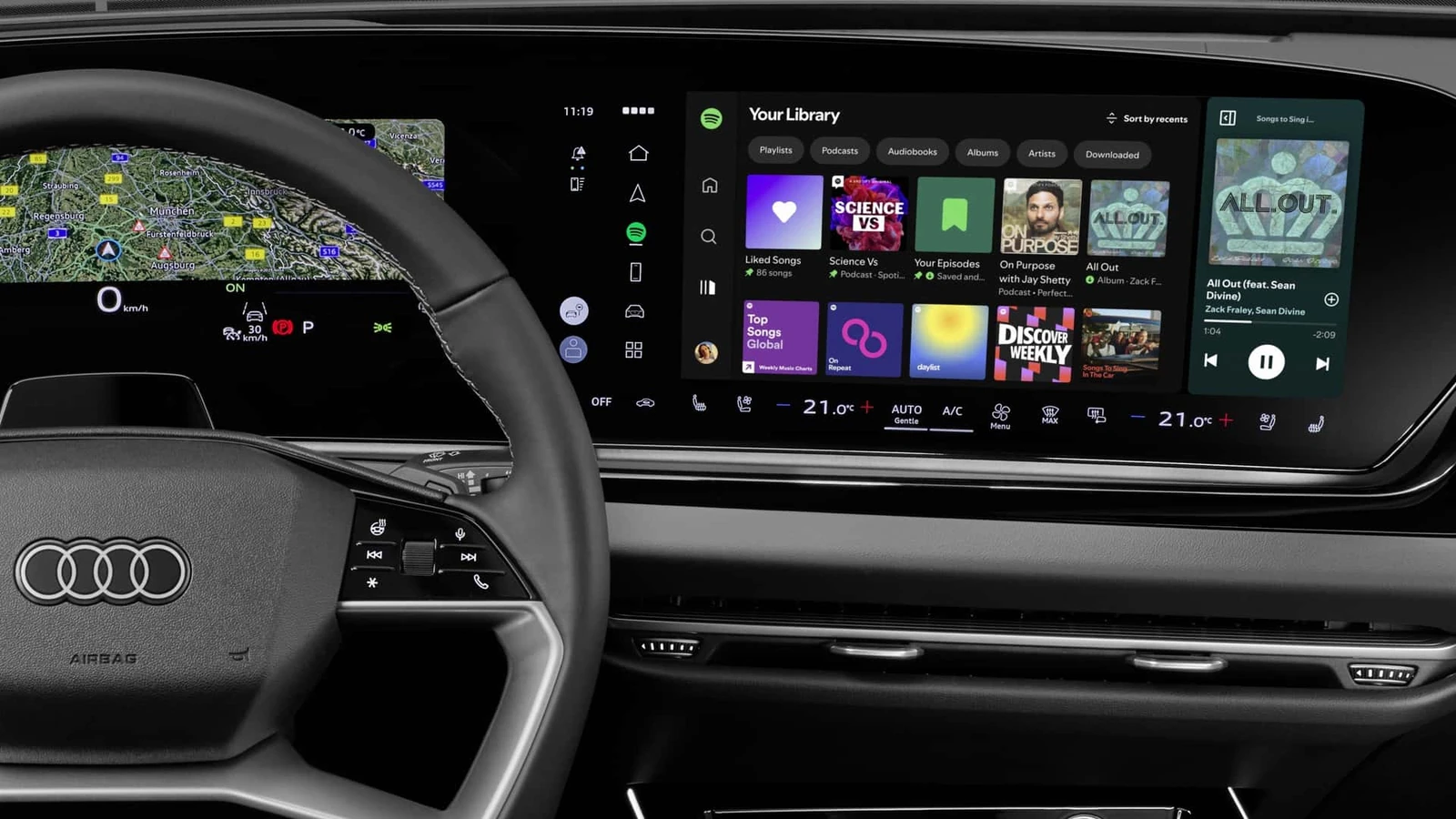
Audi is the first automaker to offer Spotify as a fully native in-car app, built directly into its infotainment system with no phone, cable or Bluetooth connection required. The app is available now in the United States on the A6 e-tron and Q6 e-tron electric models, plus the A5, Q5 and A6 combustion models from model year 2026 onwards.
It runs on vehicles built on Audi's Premium Platform Electric and Premium Platform Combustion architectures, and Audi says more current and future models on those platforms will follow, though it has not named additional nameplates yet.
What makes this Spotify app different
Spotify has offered an app for Google's Android Automotive infotainment systems before, but that version was a headless setup: Spotify supplied the data, playlists and catalogue while Google's design guidelines dictated how the interface looked. The new app is headful, meaning Spotify draws the entire interface itself rather than working inside a template or framework.
"We're drawing all the pixels," Jonathan Tarlton, Spotify's Automotive Business Development Lead, said in an interview quoted by The Verge. "We own the user experience. So we're not in a template or a framework. It's 100 percent Spotify."
That freedom lets the app use hardware that phone-projection systems cannot reach, such as passenger displays and in-car video, which is the practical reason Audi's cars can do more with Spotify than a CarPlay or Android Auto session allows.
How to install it and what it costs
Owners download the app free from the Audi Application Store on the car's infotainment system. Signing in requires a smartphone once, to scan an on-screen QR code, after which the in-car experience is decoupled from personal devices. Playback needs a Spotify Free or Premium account, the same as on a phone, and the app itself carries no charge.
Audi plans to roll the feature out across 47 markets spanning Europe, the Americas, Asia, Africa and Australia. Availability and specific features can vary by region, so the experience in Germany may not match what arrives in the US immediately.
Driving mode versus parked mode
Audi split the experience in two to stay within driver distraction rules. While the car is moving, drivers get the core Spotify menus, playback controls and voice commands through "Hey Audi" or Spotify DJ, and sign-in and settings are locked out entirely. Video waits until the vehicle is stationary, and richer visual elements such as scrolling lyrics are limited on the main screen while driving.
Park the car and the main MMI display opens up: full-screen video podcasts, music videos and live lyrics become available, including while an EV is charging. Spotify Jam lets passengers scan a QR code to join a shared session and add songs to the queue from their own phones.
Cars fitted with a separate passenger display skip most of those restrictions, because that screen sits outside the driver's view. A front passenger can browse content, read lyrics or watch video while the car is in motion. The catch is that the most distinctive features depend on hardware not every qualifying model carries, so buyers after the full experience should check whether a passenger screen is fitted before ordering.
Spotify is not abandoning phone projection
Spotify said it remains "heavily invested" in Apple CarPlay and Android Auto and wants to offer users a choice of how they access the service, whether they are tied to iOS or Android on the phone. Audi is the first automaker to ship the new app, and more manufacturers are expected to join in future, though none have been named.
For drivers, the appeal is convenience rather than new content: the same account and catalogue, minus the pairing routine at the start of every journey. The bigger shift is architectural. A carmaker handing a third party full control of its on-screen interface is a departure from the template-bound approach that has defined in-car apps so far, and it gives Spotify a template for deals with other brands.