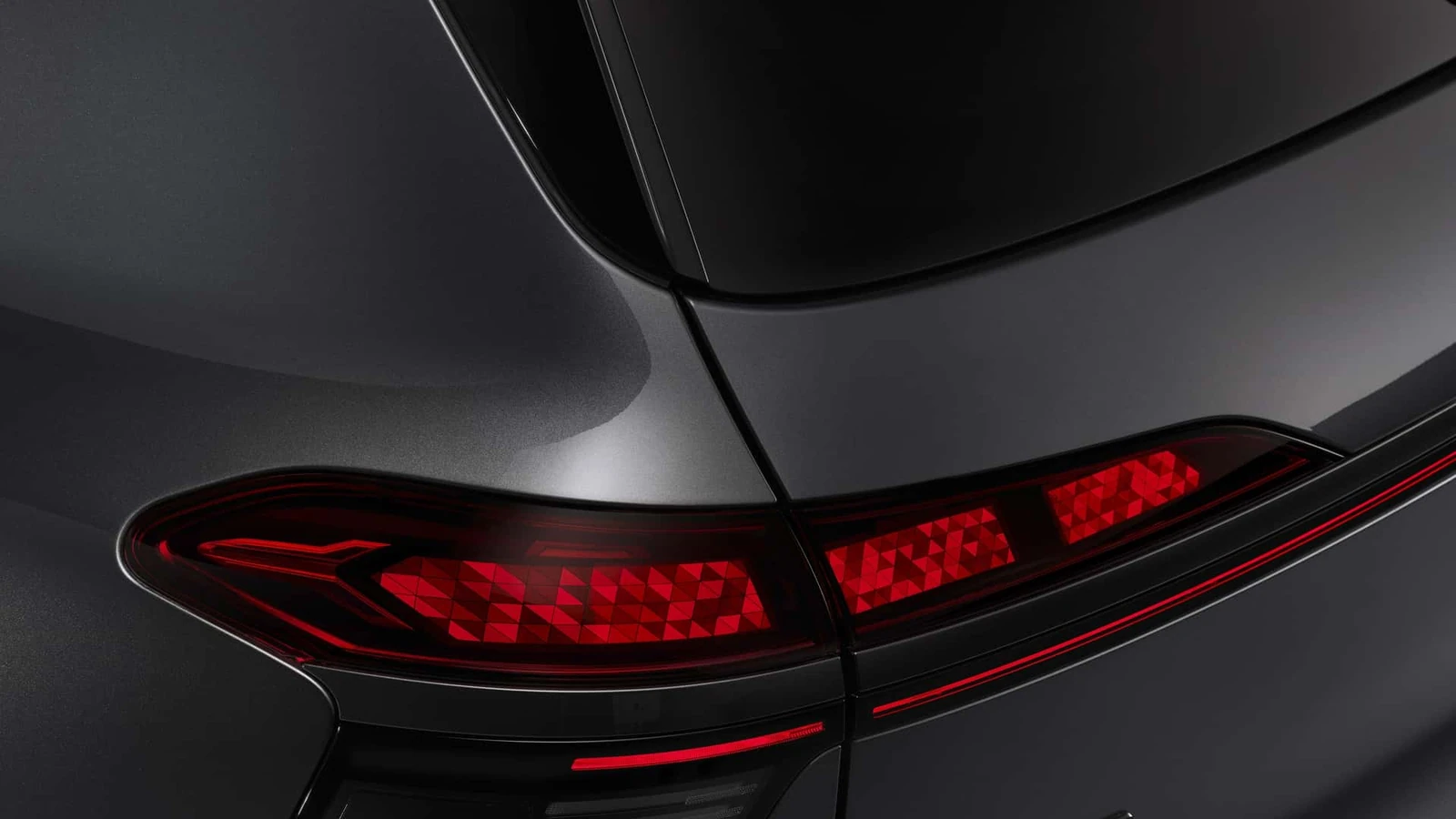
The Audi Q9 is the first production vehicle with curved digital OLED taillights, using six glass panels just 0.1 millimetres thick that wrap around the rear quarter panels rather than sitting flat behind a lens. Audi calls the setup a world first and previewed it when the Q9 debuted in July.
How the curved panels work
Conventional LED taillights sit behind flat lenses, which limits how far the light can wrap around a car's body. Audi shapes the glass substrate itself to follow the curve of the rear quarter panel, and the 0.1-millimetre glass is thin enough to bend without cracking the OLED layer bonded to it. The resulting light element measures about one millimetre thick overall, built on technology the brand has spent a decade developing for production cars.
Audi was the first automaker to put segmented OLED lighting into a production vehicle, and the Q9's digital version pushes that further. Each rear light connects to the car's electrical system control unit through a bus system, letting hundreds of segments be controlled individually instead of lighting up as one block. That fine control keeps the curved panels legible from the side, not just straight on, so a driver approaching at an angle in a parking lot or at an intersection gets a clearer view of brake and turn signals than a flat-panel light usually gives.
The six-panel layout
The lighting is split across the width of the tailgate and rear quarter panels. Audi says the outer curved panel on each side is the largest rear-light panel it has built. The breakdown is 99 segments for each outer panel, 84 for each central panel and 73 for each inner panel, adding up to the 512 total segments across all six pieces.
Up front, the Q9 pairs the OLED rear lights with digital Matrix LED headlights, and the two systems work together at night. The SUV can project a stylised turn-signal pattern onto the pavement ahead, in sync with the dynamic indicators front and rear, a feature Audi previewed on the smaller Q7 before bringing it to the new flagship. Audi's digital Matrix LED headlight technology already appears on some US models.
What Audi has not announced
Audi has shared the panel count, the segment total and the glass thickness as production specifications tied to the Q9's unveiling, but it has not detailed how much of the 512-segment system drivers can customise through onboard settings. Nor has it said whether every market gets the same signature lighting sequence at startup and shutdown. US pricing has not been announced either; those specifics are expected to become clearer as the Q9 gets closer to its on-sale date.
The gap matters for buyers weighing the Q9 against other flagship SUVs. The hardware is confirmed and shipping on the car, but the parts that owners actually interact with, the customisation options and the market-by-market light signatures, are still open questions. Until Audi publishes those details, the Q9's lighting story is a demonstration of capability rather than a full picture of what owners will get.
Why it stands out
Curved OLED lighting is rare because bending the glass without damaging the OLED layer is difficult, and Audi is claiming the first production application of it here. For drivers following a Q9, the practical benefit is a brake and indicator signal that stays readable from wider angles, which is the kind of change that shows up in everyday traffic rather than on a spec sheet. The Q9's debut came in July, and its on-sale date and pricing remain to be confirmed.