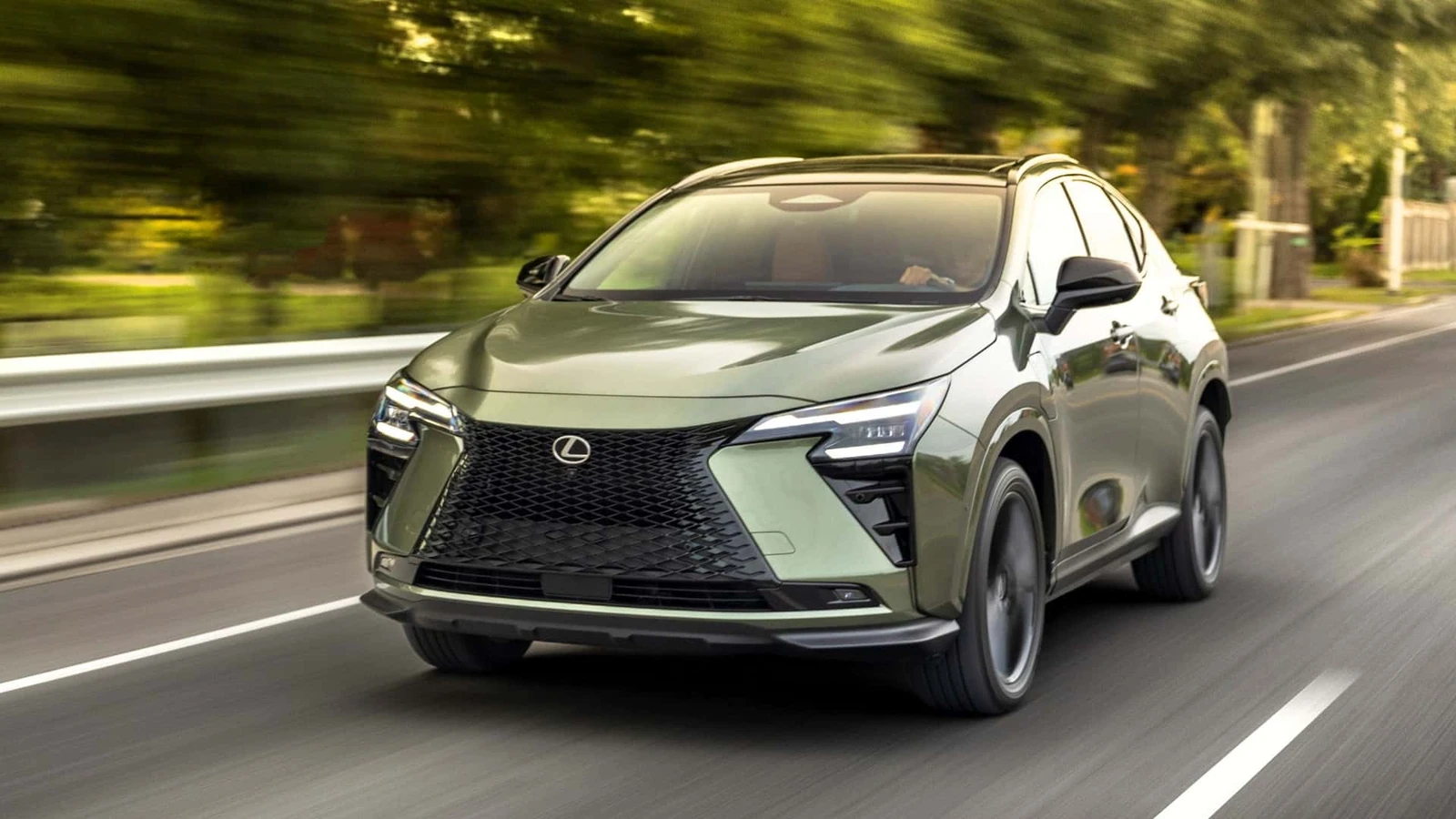
Lexus has confirmed that the 2027 NX will be sold only as a hybrid or plug-in hybrid, ending the petrol-only version's run in the compact crossover line for the first time. The updated model was unveiled on October 20, 2026, with a four-grade range built around the NX 350h hybrid and the NX 450h+ plug-in hybrid.
Both drivetrains carry more electric power than before, and the plug-in gains a larger battery, a longer electric-only range and DC fast charging for the first time. Lexus has not yet published prices, and neither the US on-sale date nor the Australian launch timing has been announced.
Four grades replace the old base trim
Buyers now choose between Premium, Premium+, F Sport and Luxury grades, with last year's entry trim dropped from the range. Premium and Premium+ pair the NX 350h hybrid with front- or all-wheel drive, while F Sport and Luxury come only with all-wheel drive. The NX 450h+ plug-in hybrid is all-wheel drive in every trim.
The exterior gets a new dual-line headlamp signature that folds the turn signals and daytime running lights into one shape, plus Lexus's first Double L taillight treatment around an illuminated logo badge. Chrome trim is largely gone, replaced by black mirror caps and window mouldings. Nine colours are offered, including Shaded Ivy, an ash-green finish, and Incognito, a grey reserved for F Sport models; Iridium replaces Atomic Silver across the range.
Inside, every NX gets a 12.3-inch digital instrument cluster and a 14.0-inch touchscreen running Lexus Interface software, with a customizable home screen and simultaneous pairing of two Bluetooth phones. A built-in drive recorder and over-the-air update capability are now standard. The steering wheel is slightly smaller in diameter than the 2026 car's, and a soft-touch horizontal panel on the dash houses translucent switches for temperature, defroster and defogger.
Luxury and F Sport buyers also get Sensory Concierge, which coordinates lighting, climate, seat temperature and scent across three modes called Inspire, Radiance and Revitalize, plus three standalone fragrances: Shinmei, Seiyo and Hanya. Lexus Safety System+ 4.0 is standard, bringing adaptive cruise control, lane centring, traffic jam assist, lane change assist, automatic high beams and automatic emergency braking with pedestrian detection, with intersection assistance and emergency steering support carried over in updated form.
More power from both electrified drivetrains
The NX 350h's combined output rises to 244 hp, 4 hp more than the outgoing hybrid, a figure that applies to both front- and all-wheel-drive versions. Its front motor makes 160 hp, and the rear axle motor on all-wheel-drive models adds 54 hp. Lexus quotes a 0-60 mph time of 6.9 seconds for the front-drive hybrid and 6.7 seconds for the all-wheel-drive version. The 1.1 kWh battery is unchanged.
The NX 450h+ jumps to 324 hp from 304 hp, with the front motor rising from 180 hp to 203 hp, a 2.5-litre petrol engine making 186 hp and a 54 hp rear motor. Lexus quotes 0-60 mph in 5.7 seconds and a 124 mph top speed.
Both powertrains use a new e-Axle that bundles the transaxle, motor and power control unit into one lighter assembly, lowering the centre of gravity, and silicon carbide semiconductors in the inverter cut electrical losses. Lexus says revised hybrid-control software draws more on electric assist during acceleration for smoother delivery, though straight-line pace stays close to last year's. The suspension and steering have been retuned and chassis rigidity improved, with the floor and suspension towers reinforced.
Plug-in battery grows to 22.7 kWh
The NX 450h+ now uses a 22.7 kWh lithium-ion pack, up from 18.1 kWh, which Lexus credits for an 8 percent gain in both output and capacity. The manufacturer estimates about 40 miles of electric-only range in one account and 45 miles in another, eight miles more than the previous model.
DC fast charging arrives for the first time: Lexus says 10 to 80 percent takes 35 minutes on a 50 kW charger, while a 6.6 kW 240-volt AC charger needs two and a half hours for 10 to 100 percent. In North America the plug-in will carry a native NACS port.
The NX 350h is built at Toyota's Ontario, Canada, plant and at Kyushu in Japan, while the NX 450h+ comes only from Kyushu.
Pricing and timing still open
Lexus has not disclosed pricing for any of the four grades, saying figures will arrive closer to the on-sale date. No US launch date has been announced, and Lexus has not confirmed Australian availability or pricing for the 2027 NX.
Dropping the petrol-only trim narrows the NX's appeal at the bottom of the range, where a lower entry price has historically pulled buyers into the model. With the hybrid now the cheapest way in, the question for shoppers is whether Lexus can hold the line on price; that answer depends entirely on the figures still to come.