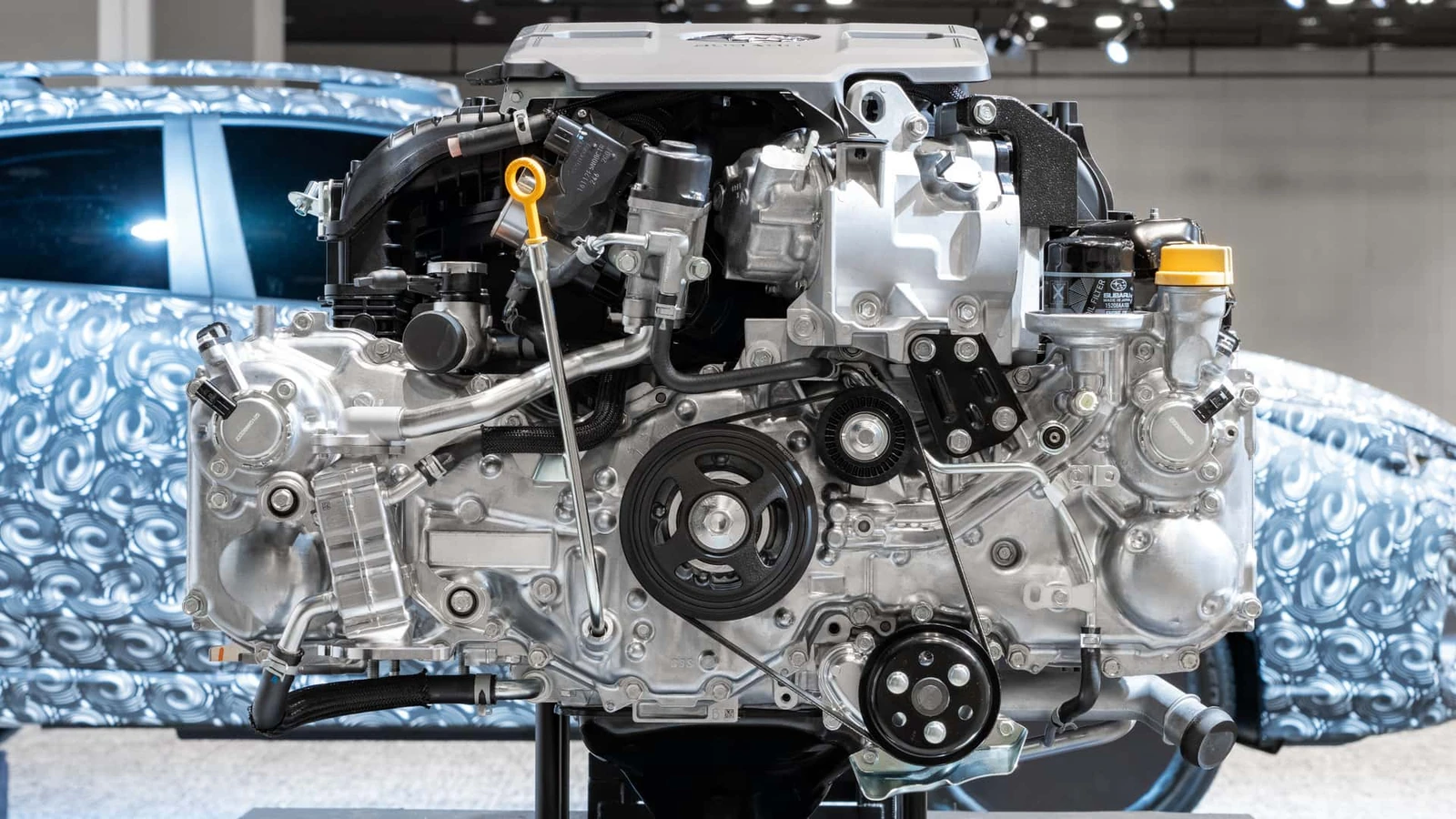
Subaru is developing a next-generation flat-four engine with a 50 percent thermal-efficiency target, the clearest detail yet on what comes next for the layout that has defined the brand for decades. The company outlined the goal and early development results at a briefing covered by Japanese magazine Motor-Fan.
The 50 percent figure is a development target, not a confirmed specification, and Subaru has not said when the engine will reach production or which models will get it first.
What Subaru says the development engine can do
According to data Subaru presented at the briefing, the development engine has roughly twice the operating range with high thermal efficiency compared with the naturally aspirated engine currently used in its hybrid models. The prototype is a direct-injection turbocharged unit, while the reference powertrain is naturally aspirated.
Subaru's engineers have focused on strengthening airflow inside the cylinders so air and fuel mix more thoroughly before ignition, and the development boxer already generates stronger in-cylinder airflow than competing benchmark engines despite keeping a relatively short stroke. The company has also added three-dimensional combustion analysis to its development process, which lets engineers predict how flames spread after ignition and anticipate knocking.
Expanding the efficient operating range matters because an engine that only returns strong fuel economy in narrow conditions does little for real-world consumption. Subaru's claim is that its prototype holds high efficiency across a wider spread of driving situations, though the figures come from Subaru's own testing rather than independent measurement.
Technologies under consideration for the 50 percent goal
Subaru is exploring a variable-geometry turbocharger, which adjusts the turbine's flow passages depending on exhaust gas volume and could improve responsiveness, though the company acknowledges electric motor assistance could also offset turbo lag. A Miller cycle approach, which alters intake valve timing for a more favourable compression-to-expansion relationship, is also on the table; it lowers exhaust temperatures, which could make a variable-geometry turbo easier and cheaper to fit.
Subaru concedes those measures alone probably will not reach 50 percent thermal efficiency. Pre-chamber combustion is the remaining piece under study, a technology BMW recently introduced on the inline-six used in the M2, M3 and M4 sold in Europe to meet stricter emissions rules.
Forced induction gives Subaru more control over how much air enters the cylinders, helping deliver stronger torque over a broader range, which is part of why the turbocharged prototype outperforms the naturally aspirated reference on efficient operating range.
Why Subaru is sticking with the boxer
The flat-four effort traces back to a 2024 announcement in which Toyota, Mazda and Subaru committed to developing new combustion engines, each pursuing its own technology: Toyota a family of smaller four-cylinders, Mazda its rotary and a new Skyactiv-Z inline-four, and Subaru its horizontally opposed engine. Toyota and Mazda have since detailed their plans; Subaru had stayed quiet until this briefing.
Subaru could have abandoned the layout, but keeping it preserves an identity the brand has built its cars around while still chasing efficiency gains. The contradiction is that Europe will not see much of the result: Subaru has said it will move to an electric lineup on the continent by 2028, ending sales of new petrol models there. The boxer may remain central elsewhere, but its time in European showrooms is limited.
What is still unknown
Subaru has not announced a production timeline for the next-generation boxer, nor which models will receive it first, and engineers are still working through technical challenges. The 50 percent thermal-efficiency figure remains an ambitious development goal rather than a settled output.
For buyers, the practical read is that Subaru intends to keep improving combustion engines in markets where they still sell, rather than treating the boxer as a legacy item to be retired everywhere at once.