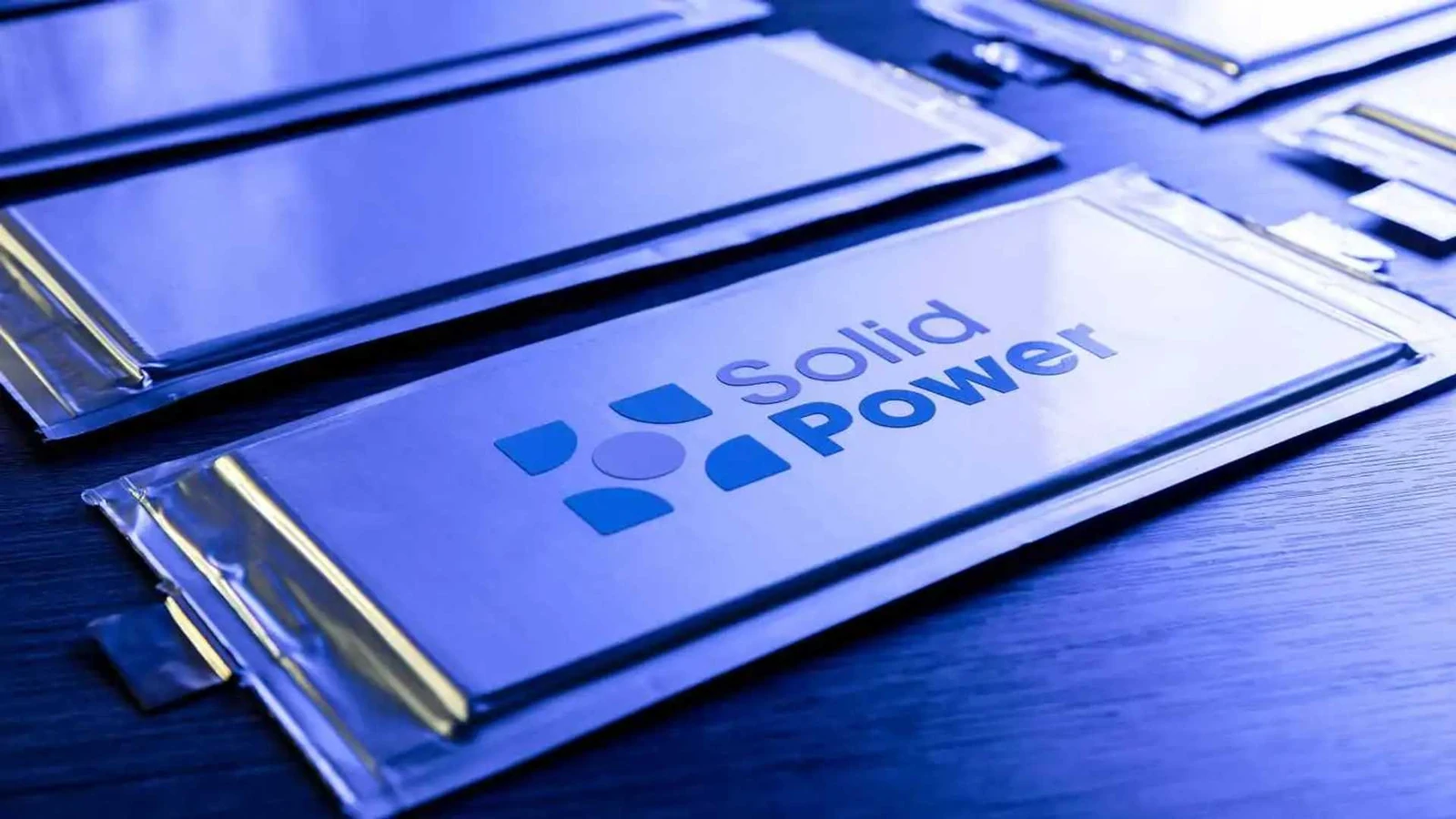
Solid Power has commissioned a pilot production line for its sulfide-based solid electrolyte at its Thornton, Colorado plant, a step toward selling the material to battery and car makers rather than building complete cells itself. The Mobius line is expected to be operational by the end of the year and would add 45 metric tons of annual solid electrolyte capacity, taking total pilot capacity to 75 metric tons a year when combined with existing facilities.
The company has already worked with Ford, BMW, Samsung SDI and SK On, plus names not yet publicly announced, and says its joint development agreements with Ford and BMW are complete. Its focus is now shifting to working with major battery manufacturers on how to scale production.
What Solid Power actually sells
Solid Power specialises in one ingredient of a cell: the electrolyte that carries lithium ions between the electrodes. In a conventional lithium-ion battery that electrolyte is usually a flammable liquid; solid-state developers are working with polymers, oxides or sulfides, and Solid Power is betting on sulfides.
President and CEO John Van Scoter told InsideEVs that the company's flexible sulfide design is intended to let established battery makers fold the technology into their existing production processes. "We can use standard [lithium-ion battery] roll to roll equipment in order to build all solid state cells," he said. That matters because it means the technology should not require brand new factories or expensive retooling, a claim that rests on Solid Power's own engineering assessment rather than independent testing.
The performance claims and their limits
Solid Power says its electrolyte paired with a silicon anode and a nickel manganese cobalt cathode can lift a cell to 390 watt hours per kilogram and last more than 1,000 cycles. With a lithium metal anode, the company claims energy density can reach 440 Wh/kg, close to double an average lithium-ion battery today. For comparison, modern NMC batteries with liquid electrolytes typically deliver around 250 to 280 Wh/kg.
Those figures are theoretical. The final energy density depends on the battery maker that builds the actual cell, and Van Scoter is explicit about the division of labour: "We create the magic that allows the cell to work. But it's up to the cell design as to energy densities, cycle life, all those other important attributes".
Solid Power also says it has put substantial engineering effort into dendrite formation, the needle-like lithium structures that can grow inside a cell and cause short circuits or capacity loss.
BMW, Samsung SDI and the missing timeline
BMW released images last year of a prototype i7 fitted with a solid-state battery using Solid Power's silicon anode technology. BMW, Samsung SDI and Solid Power have also entered a three-way agreement in which Samsung SDI would manufacture the cells, BMW would develop the modules and packs, and Solid Power would supply the electrolyte.
When that partnership will produce cars has not been announced. Solid Power's own expectation is that solid-state batteries reach select high-end EVs by the end of this decade, with broader adoption in the early 2030s. The three-way agreement's exact timeline remains unclear.
The company also secured a $50 million U.S. Department of Energy grant in 2024 under the Bipartisan Infrastructure Law to support its development work.
Why the electrolyte-only model is the bet worth watching
Solid Power is taking a different route from some American rivals. QuantumScape is working with Volkswagen, Honda and other automakers to commercialise its own cells, while Mercedes-Benz and Stellantis have begun testing prototype vehicles fitted with Factorial's solid-state cells. Selling the electrolyte instead of the whole cell lowers the manufacturing risk Solid Power carries, but it also hands the final performance numbers to its customers.
Van Scoter argues the technology could be the route back for the U.S. into a battery industry dominated by Asian manufacturers: "All solid-state batteries can be the way that [the U.S.] can get back in and be competitive in the battery industry".
Solid Power thinks the technology may mature first in defence applications, drones and humanoid robots, where qualification cycles are shorter and platform cycle life is much faster, according to Van Scoter. For car buyers, that suggests the first meaningful volumes of this chemistry may arrive somewhere other than a passenger car.