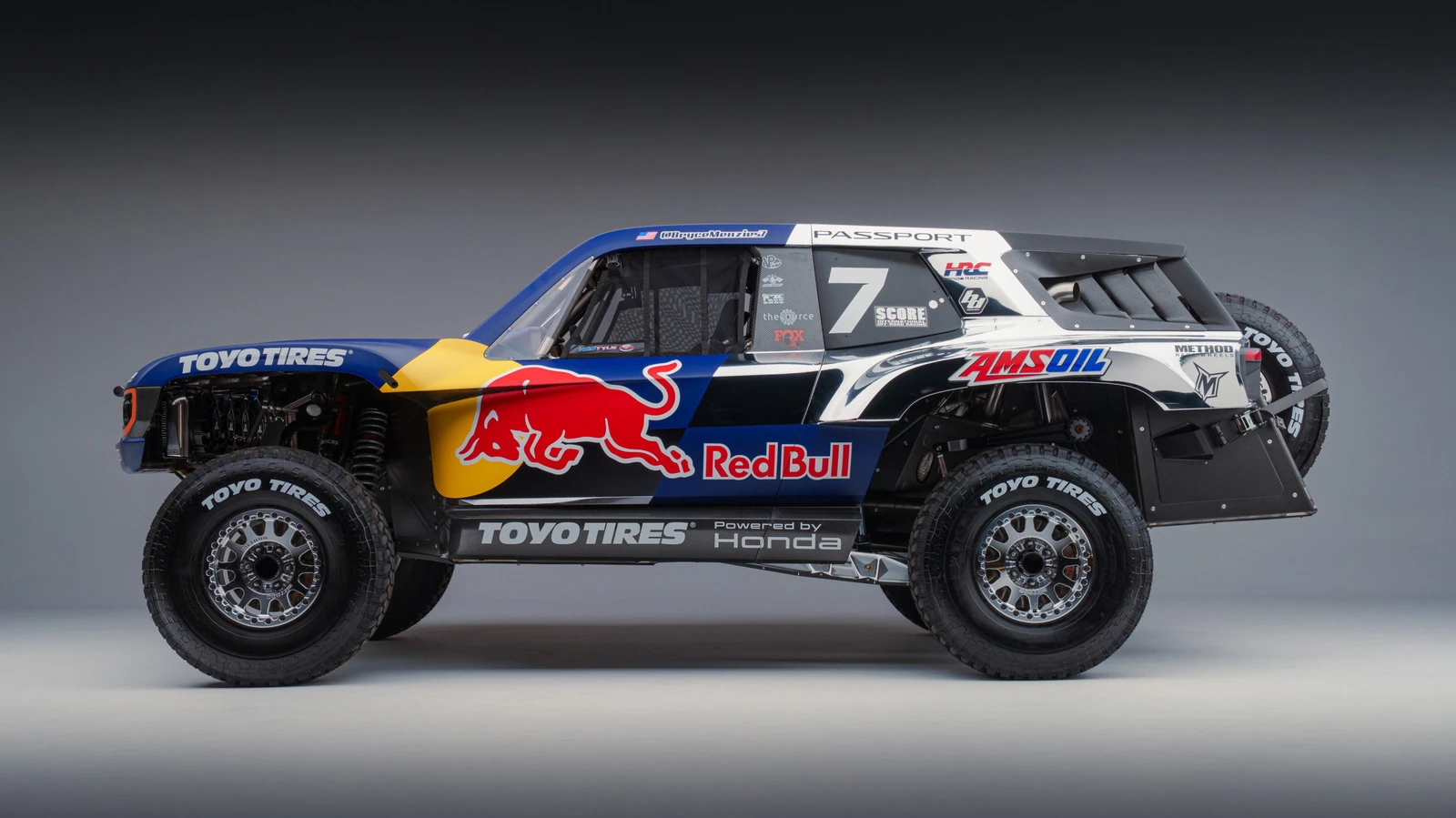
Honda Racing has turned the Passport into a trophy truck, a 1,300 hp (969 kW) desert racer built with Mason Motorsports that is intended to contest the top class of the Score World Desert Championship. The truck is scheduled to make its public debut at the 2026 SEMA Show, which runs from November 3 to 6 in Las Vegas.
Honda says it will be the first hybrid vehicle to compete in that championship's premier Trophy Truck class, a category whose established machinery is built around large naturally aspirated V8s.
A V6 from the endurance racing side of the business
The powertrain is a 2.4-litre V6 with two turbochargers, an engine Honda describes as closely related to the unit in Acura's ARX-06 GTP race car, which has won at Daytona and Sebring. Honda claims the combination of that engine and an 800-volt hybrid system produces more power than the 9.0-litre V8s that today's trophy trucks typically use.
The hybrid hardware is Honda Racing's own work rather than an adapted road-car system. Its battery uses a previous-generation Formula 1-style pouch cell in a carbon fibre case, assembled and validated in a clean room at the company's Santa Clarita headquarters. Honda has not disclosed the battery's capacity or how much of the 1,300 hp comes from the electric side, so the split between combustion and electrical output is still unannounced.
That silence is a gap worth watching. A 1,300 hp total figure tells you what the truck can do, but not how it does it, and in desert racing the useful question is how much torque the electric side can supply when the V6 is off boost or when traction is marginal. Honda's answer will presumably arrive with the racing programme itself.
Brake-by-wire, AI power deployment and a Mason chassis
Honda says the truck carries brake-by-wire systems on each axle, adaptive traction control and a function it calls AI power deployment. Proprietary software links powertrain, chassis and energy management, and can be adjusted during a race.
The rear-mounted engine drives through a Mason-developed five-speed transmission. The all-wheel drive layout uses two rear driveshafts with individual angled gearsets at the rear wheels in place of a conventional ring-and-pinion, while portal gearsets at the front hubs help with ground clearance.
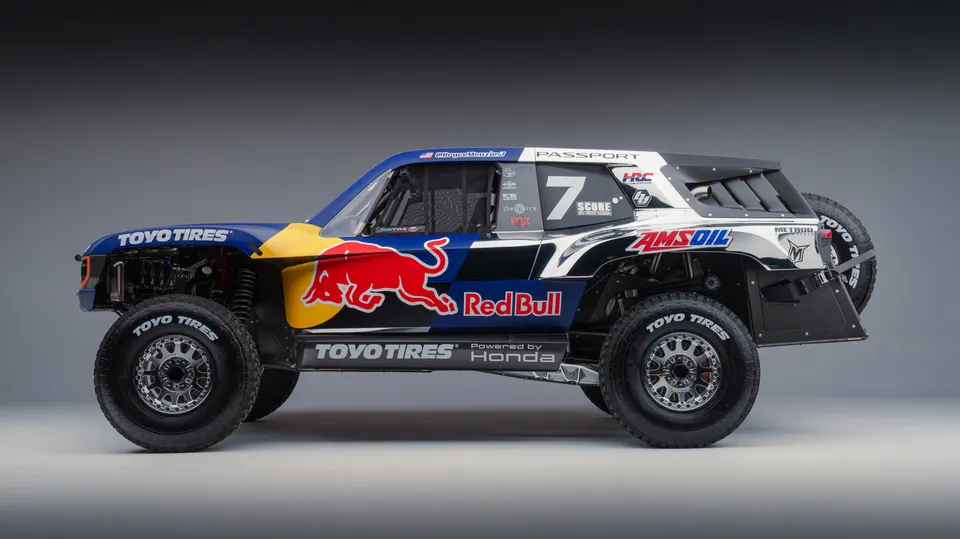
Underneath is a modified version of Mason's Gen 2 AWD chassis, with an HRC-specific rear section to house the hybrid components. A 145-gallon (549-litre) carbon-Kevlar fuel cell sits in the centre of the cab to keep weight distribution consistent as fuel burns off; a full tank weighs roughly 899 pounds (about 408 kg) more than an empty one. Batteries and other fixed-weight parts are mounted toward the rear. Dual Fox shocks at each corner and Toyo tyres complete the desert specification.
The body is carbon fibre throughout, with deep channels behind the front wheels to manage airflow, high-mounted exhaust outlets among fins behind the cockpit, and a cab shaped to feed air to a cooler mounted low and far back. Beyond the name, only selective sections of the body hint at the production Passport.
SEMA debut, then the 2027 Baja 500
The trophy truck will be shown at SEMA alongside a Passport TrailSport Baja Chase truck. Its first scheduled race is the 2027 Baja 500, set for June 2 to 6, with an overall win at the 2027 Baja 1000, held in the event's 60th anniversary year, as the larger target.
Two-time Baja 1000 winner Bryce Menzies will drive it, with Menzies Motorsports as a partner on the programme.
Honda has the horsepower figure it wanted. What the programme now has to demonstrate is durability: a hybrid system developed for sprint-format endurance racing has to survive a full desert distance, and the truck's competitiveness will be judged on finishes before it is judged on output.