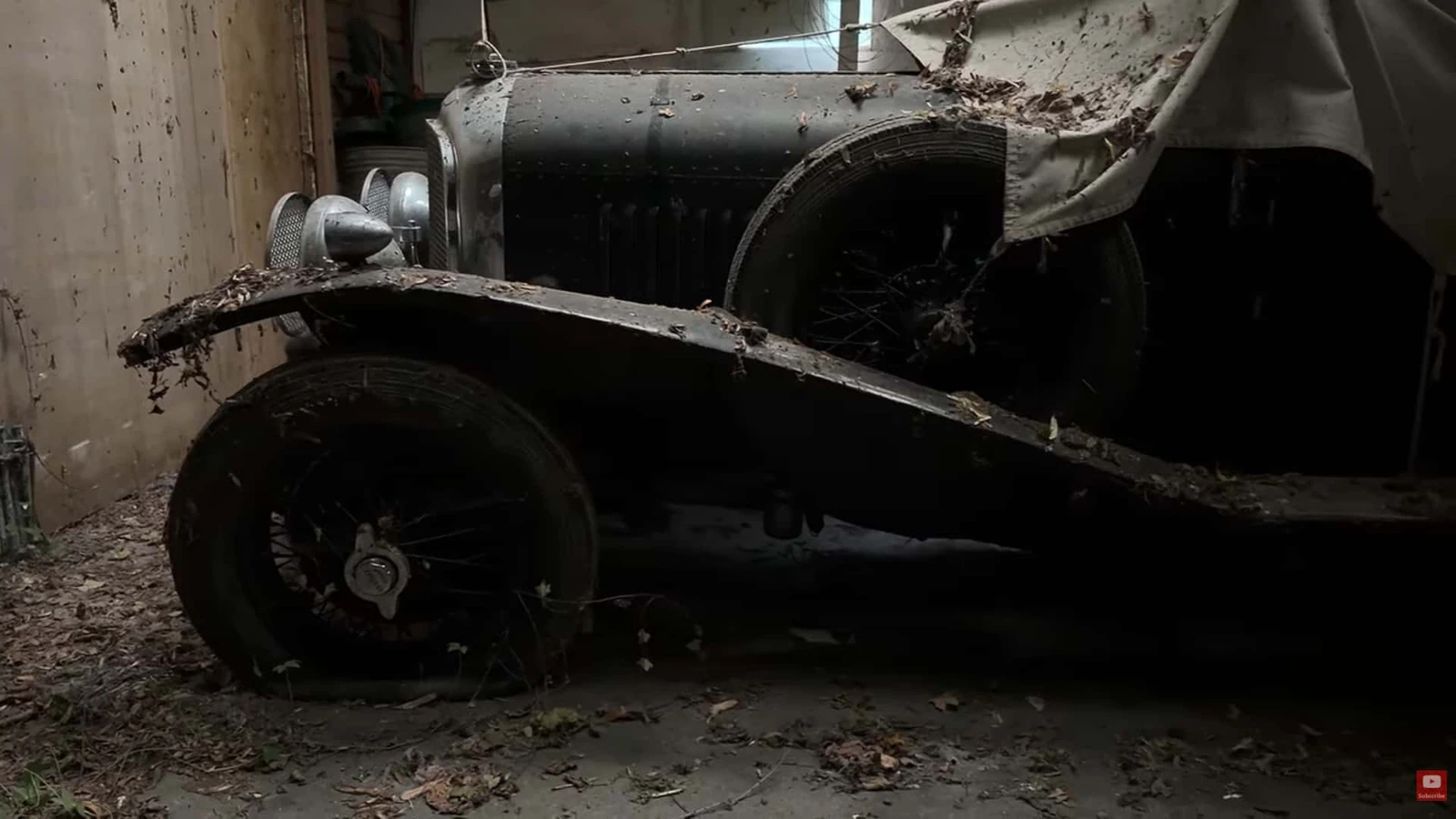
A 1928 Bentley 4.5 Litre Sports Tourer with its Vanden Plas coachwork still attached has been found in an abandoned property in the UK, according to Motor1. Colin Smith, who films explorations for his YouTube channel The Bearded Explorer, came across the car while filming the derelict building.
The discovery matters because the body style is scarce: Bentley built roughly 720 examples of the 4.5 Litre between 1927 and 1931, and Vanden Plas bodied only 204 of them, of which just 148 were finished as four-seat tourers like this one. More than 50 of those cars left the factory in 1928, placing this example in the earliest and smallest production window for the model.
Why an intact Vanden Plas body is the story
Pre-war Bentleys rarely survive with their original coachwork in this condition, since barn storage is hard on wood-framed bodies and thin steel panels. A Vanden Plas tourer that still carries its factory body and has never been through a fire is unusual even before the chassis numbers are checked.
Under the bonnet, the 4.5 Litre used a naturally aspirated 4.4-litre inline-four fed by two carburettors, rated at 110 horsepower in standard touring trim.
A registration check reportedly traced the car's factory finish to black, though whether the paint is original or a later repaint still needs verification. That question sits at the centre of any valuation, because matching-numbers cars with documented history trade in a different market from cars with gaps in the paperwork.
The price gap between similar cars
Recent auction results show how widely two outwardly similar Vanden Plas Bentleys can land. A 1928 example sold at Broad Arrow's Villa d'Este sale in May 2026 in roughly the mid $400,000 range, based on publicly available valuation summaries.
Chassis RL3427, carrying matching numbers and an unbroken ownership history, brought $1,105,000 at RM Sotheby's Monterey sale in 2021. An original-bodied Vanden Plas Semi-Le Mans Tourer sold for $2,750,000 at Gooding & Company's Amelia Island auction in 2013, lifted by its racing pedigree and factory-correct coachwork.
That spread runs from under half a million to nearly three million dollars for cars sharing a chassis and an engine. The lesson for anyone following this find is that buyers at this level pay for paperwork as much as sheet metal, and a barn find with no sale history starts well behind a car with a documented chain of ownership.
Supercharged money versus naturally aspirated money
The Bearded Explorer offered a blunt read on where this car fits: "This barn find is the naturally aspirated flavor, which still means seven figures is realistic once it's authenticated and restored, just not Blower money," they said, drawing a line between this car and Bentley's supercharged variants.
Whether Smith's discovery lands closer to those mid-$400,000 results or climbs toward seven figures depends on work nobody has done yet: confirming matching numbers, tracing the ownership record, and assessing how much of the original coachwork survives beneath years of neglect. Provenance research on cars at this level often takes longer than the restoration itself.
Nothing has been announced about a restoration, a sale or an asking price, so the car's next chapter is still open.