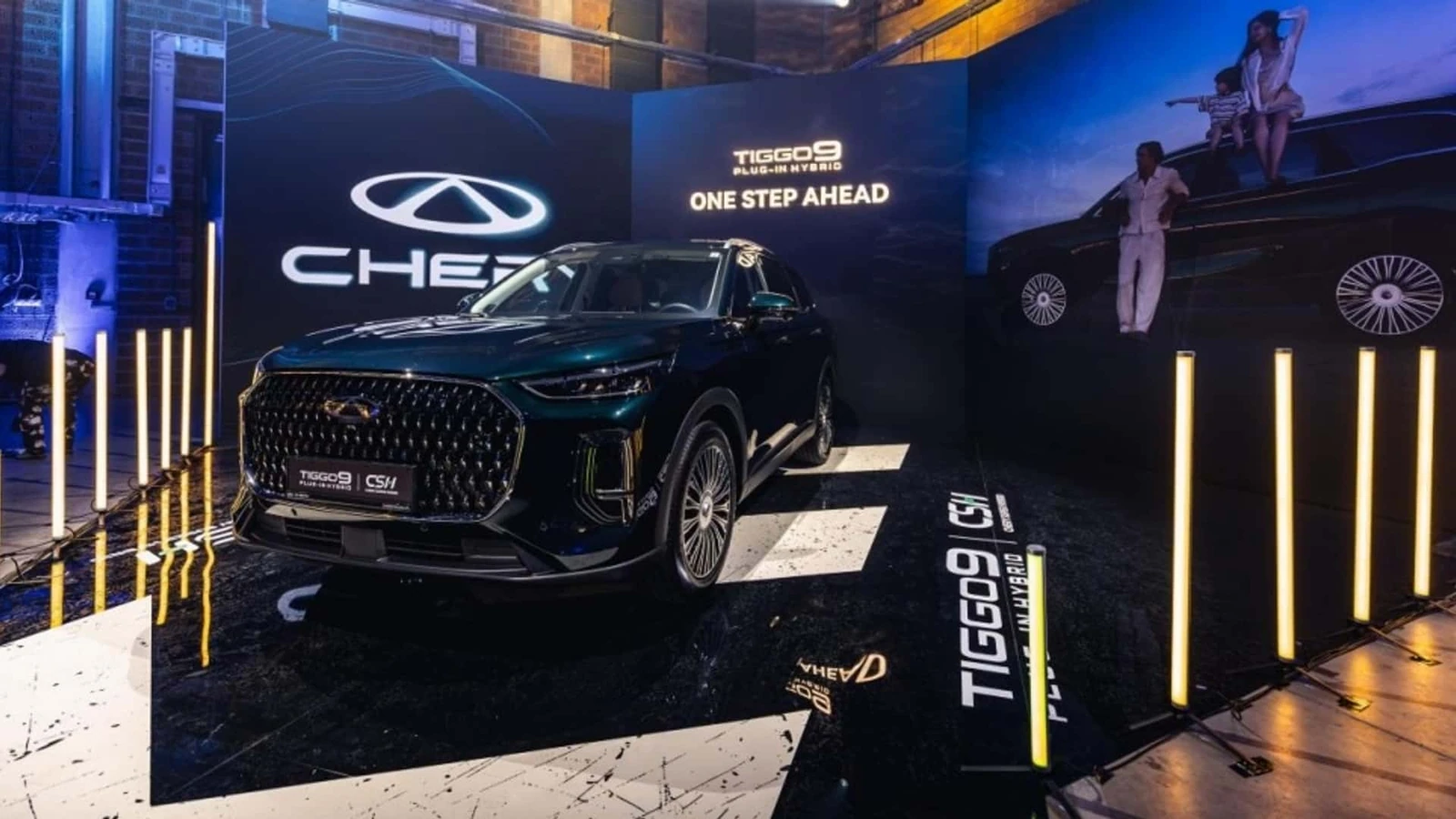
Chery has unveiled a charging technology it calls Volt-dragon, claiming it can take an electric vehicle battery from 10% to 97% in under seven minutes. The automaker presented the system at its Global Innovation Conference in Wuhu, China, on October 20, alongside a charging station that combines solar generation, energy storage and vehicle-to-grid capability.
In its official announcements, Chery says the system can add 500 kilometres (about 311 miles) of driving range in five minutes, and it plans to establish 20,000 V2G-enabled stations worldwide by 2029. The company has not said which of its cars can use the technology, what size battery was tested, or when customers will be able to access the charging performance.
What Chery has and hasn't said
Chery's English-language releases confirm the five-minute range claim and the 20,000-station ambition, but they do not include the 6 minute 50 second charging time. That figure comes from Chinese reporting at the event, which said a room-temperature test took the battery from 10% to 97% in six minutes and 50 seconds. The range claim also lacks a specified test cycle, although it is likely China's CLTC standard.
The charging equipment's advertised peak specifications are 1.44 megawatts and 1,500 amps. That does not mean the car actually drew 1.44 MW throughout the session, and it clearly did not maintain that rate for the whole charge.
Chery says the charging cable and connector together weigh just 2 kilograms (4.4 pounds), and that operating noise stays below 50 decibels. Further down the road, it envisions robotic arms that could plug in for an even more seamless charging experience.
A charging race measured in seconds
Chery is joining a Chinese charging race that is increasingly measured in seconds. In March 2024, Li Auto revealed the Mega minivan, claiming it could add 500 kilometres of range in 12 minutes. Later that year, Zeekr was advertising a 10-80% charge in 10.5 minutes using its upgraded LFP battery and compatible ultra-fast chargers.
BYD's March 2025 Super e-Platform reveal raised the stakes with a 1,000-volt architecture supporting megawatt charging, claimed to add 249 miles (400 kilometres) in five minutes. BYD also named the first cars with this capability, the Han L sedan and Tang L SUV. One year later, BYD's second-generation Blade battery focused on reaching higher states of charge, charging 10-70% in five minutes and 10-97% in nine. BYD also claimed a 20-97% session at minus 30 degrees Celsius would take only about three minutes longer than its room-temperature benchmark.
Hongqi has revealed an experimental ultra-fast-charging battery that reportedly reached 10-70% in three minutes and 41 seconds and 10-97% in eight minutes and three seconds, with no clear production timeframe. Parent company Dongfeng followed with a prototype charger rated at 1,500 kW per connector. Last month, Xpeng announced a megawatt charging station in Hong Kong, while battery supplier Sunwoda presented a system claiming 10-70% in five minutes and 10-97% in nine. On September 23, Geely unveiled a 2,250-kW charging system, claiming prototype Lynk & Co 10 and Zeekr 001 vehicles achieved 10-70% in four minutes and 30 seconds and 10-97% in eight minutes and 40 seconds.
The missing production plan
Chery's demonstration is competitive alongside those examples, but the manufacturer left out the all-important production plan. It did not identify the test vehicle or its battery capacity, and it did not say when the technology would reach the market.
The clear takeaway is that Chery did not just want to show a very high charging rate. It wanted to show how a station integrates electricity generation and storage, and how bidirectional charging lets compatible vehicles return energy to the grid. That matters because a charging network that generates and stores its own power can ease pressure on local grids, while V2G capability can turn parked cars into temporary energy reserves.
For drivers and car buyers, the headline number is less useful than the details Chery has not supplied. A charging time without a named car, a known battery size and a production date is a laboratory result, not a buying decision. The smarter move is to watch which Chery model first ships with the hardware and whether the 20,000-station plan includes the markets where that car is sold.