INDEPENDENT AUTOMOTIVE NEWSGLOBAL PERSPECTIVE / AUSTRALIAN EDITION
TDCNTHE DAILY
CAR NEWS.

The road ahead.
Every day.

RSS ↗
Latest/New cars

301 original articles

New cars / TDCN ORIGINAL

Nissan Pathfinder 40th anniversary marked with supercharged V6 and V8 SEMA builds

Builder Nicholas Scherr has turned two older ladder-frame R51 Pathfinders into the Trackfinder and Trailfinder, one supercharged and lowered, one lifted with a V8.

Image: Carscoops

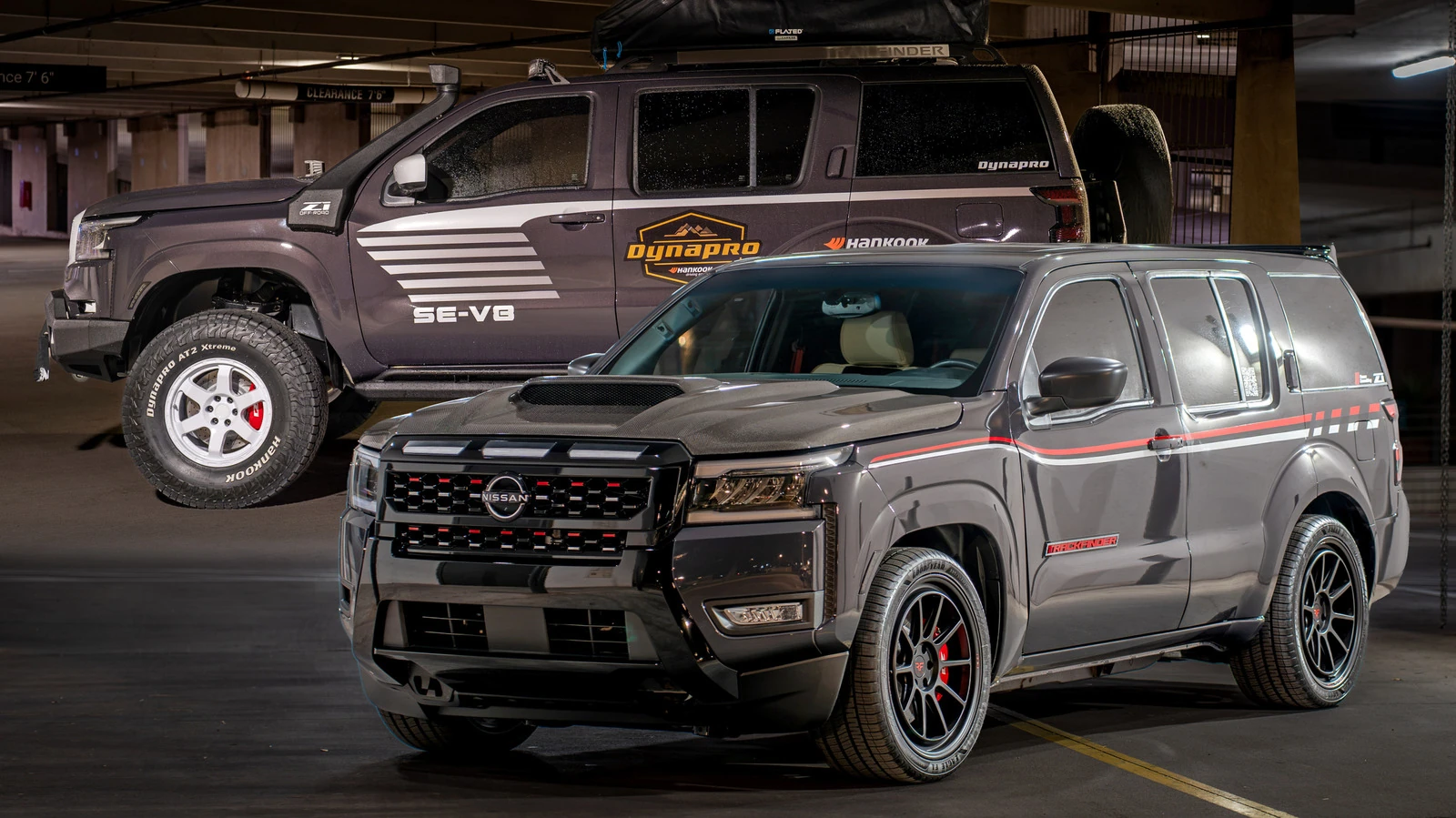
Nissan's Pathfinder turns 40, and builder Nicholas Scherr, known as Nismo Nick, is marking the anniversary at SEMA 2026 with two custom R51-generation SUVs pulled in opposite directions: a supercharged, lowered Trackfinder and a lifted V8 Trailfinder. Both make their public debut at the Las Vegas show.

Why the builder started with the R51

Scherr chose the R51 Pathfinder rather than the current model because it was the last generation to ride on a rugged ladder-frame chassis before the nameplate switched to car-like unibody underpinnings. That choice gives both builds a truck foundation to work from, which is what makes the two very different treatments possible on the same base vehicle.

The pair follow Scherr's V8-powered Xterra restomod from last year's SEMA show. Both wear components from the current D41-generation Nissan Frontier, including the grille, LED headlights, front fenders, front doors, LED taillights, dashboard, centre console and door panels, a swap intended to modernise their appearance inside and out. They also share Ruby Slate Pearl paint borrowed from the 2021 Nissan Maxima 40th Anniversary sedan.

Trackfinder: supercharged V6, manual gearbox, lowered stance

The Trackfinder takes its inspiration from the GMC Typhoon and adds Nismo flavour to the Pathfinder. It sits closer to the ground on forged 20-inch black wheels, with cross-drilled and slotted brake discs clamped by red calipers visible behind the spokes.

Visual changes include glossy black trim and red accents on the Frontier face swap, special logos on the front doors, red and white stripes along the profile, a Seibon carbon fibre hood with a prominent scoop, a rear spoiler and quadruple tailpipes emerging from the rear bumper.

Its 4.0-litre V6 is upgraded with a Z1 Off-Road supercharger, custom carbon fibre intake piping, a heat-shielded airbox and an UpRev tune, lifting output to 501 hp (374 kW / 508 PS), close to double the standard figure. Drive goes through an Xterra-sourced six-speed manual gearbox with a Centerforce clutch and flywheel. A supercharged V6 and a manual in a lowered, street-focused SUV is an unusual combination, and it is the part of the build most likely to appeal to drivers who associate the Pathfinder name with family transport rather than performance.
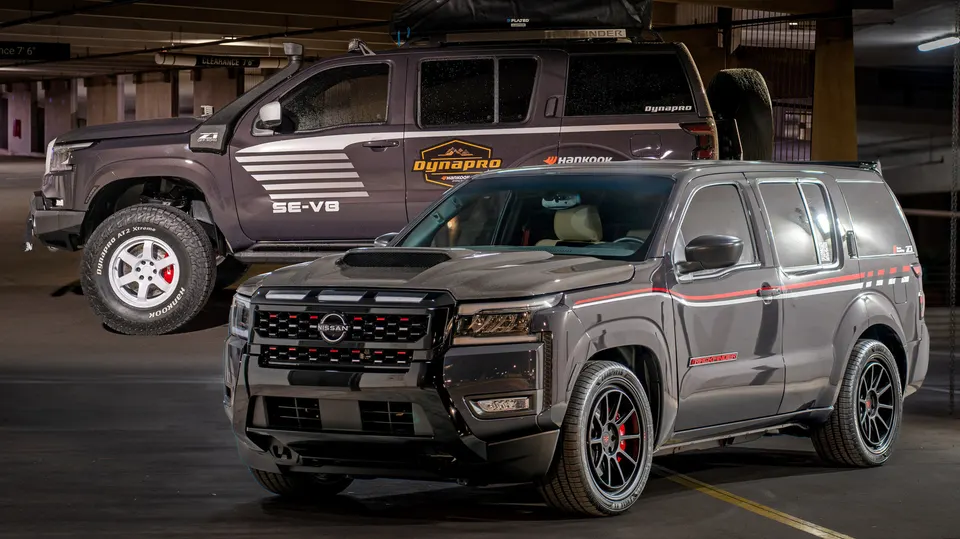
The supercharged V6 Trackfinder and V8 Trailfinder concepts share the spotlight ahead of SEMA
The supercharged V6 Trackfinder and V8 Trailfinder concepts share the spotlight ahead of SEMA, Image: Carscoops

Trailfinder: V8 power and serious off-road hardware

The Trailfinder was designed as a "love letter" to body-on-frame SUVs with V8 power. Its ground clearance comes from a lifted suspension and 35-inch Hankook Dynapro AT2 Xtreme tyres wrapped around white alloy wheels.

The Frontier face is combined with Hammerhead Armor steel bumpers and rock sliders, plus a front winch, dual recovery shackles, a rear swing-out spare tyre carrier and a roof rack carrying a tent. Rigid Industries supplies extra LEDs, and Trailfinder lettering appears on the roof rack, the spare wheel cover and the white grille surround.

Under the hood is a 5.6-litre V8 fitted with a Z1 Off-Road intake and snorkel. The suspension uses the X-Pro Titan Swap Package and a Z1 Off-Road big brake kit, while the Frontier-sourced dashboard is finished in red to match leather seats with tartan cloth inserts. Where the Trackfinder chases street performance, the Trailfinder is built around the equipment off-road drivers actually use: clearance, recovery gear and a place to sleep.

Build support and show details

Both vehicles were built with the support of Pinnacle Nissan in Scottsdale, Arizona. Nissan has not announced production plans for either build, so for now they stand as show cars rather than models buyers can order.
Open this article ↗
New cars / TDCN ORIGINAL

BMW's Symbiotic Drive brings hands-off city driving to Germany in 2027

The Level 2 system handles roundabouts and urban lane changes using hardware already fitted to the iX3, iX4, X5, 3 Series and facelifted 7 Series, activated by an over-the-air update.

Image: Carscoops

BMW will introduce a driver assistance system that can steer, brake and accelerate through city streets without the driver's hands on the wheel, starting in Germany in 2027. The software, called BMW Symbiotic Drive, adds urban lane changes, yielding to traffic with the right of way and roundabout handling to the company's existing Highway Assistant technology.

The hardware needed for the system is already installed in the latest BMW models, including the iX3 and iX4 electric SUVs, the new X5, the new 3 Series and the facelifted 7 Series. Each carries BMW's Panoramic Vision display at the base of the windshield, which shows the status of the assistance and the upcoming automated maneuver on the touchscreen.

How the system works and what it covers

BMW's current Highway Assistant can steer, brake and accelerate on highways, change lanes with hands off the wheel, and stop at red lights before pulling away when they turn green. Symbiotic Drive extends those abilities to urban driving when BMW Maps is active, and BMW says the combined capabilities allow a trip from a freeway network through country roads and into a city without touching the wheel.

The system is rated at Level 2 under the Society of Automotive Engineers framework, the same classification as Ford's BlueCruise and GM's Super Cruise. That means drivers must keep their eyes on the road even with hands off the wheel. A camera monitors attention, and if the driver is distracted the car reverts fully to manual control. So the technology eases the tedium of city driving without allowing commuters to scroll through their phones or finish a presentation.

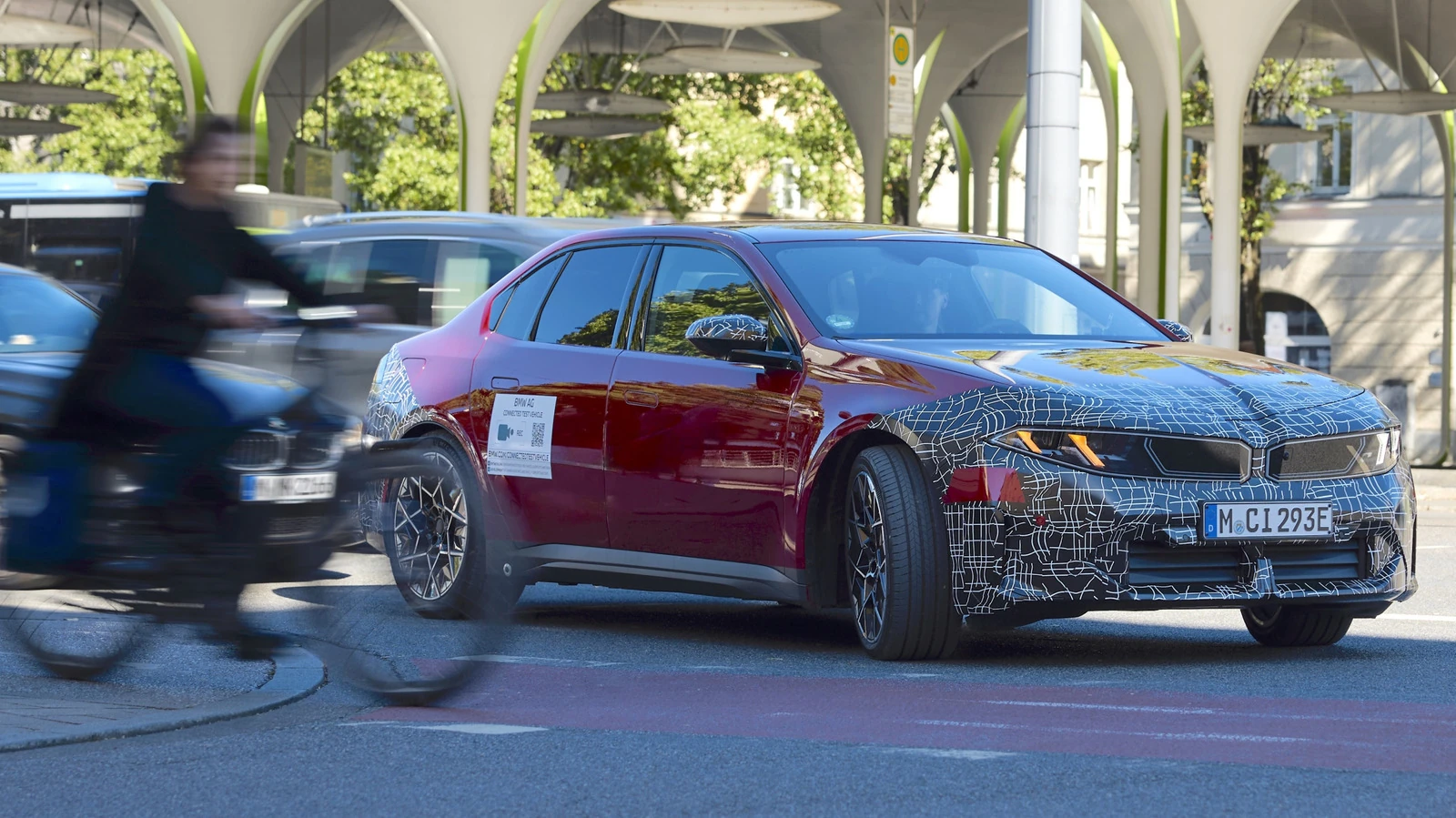
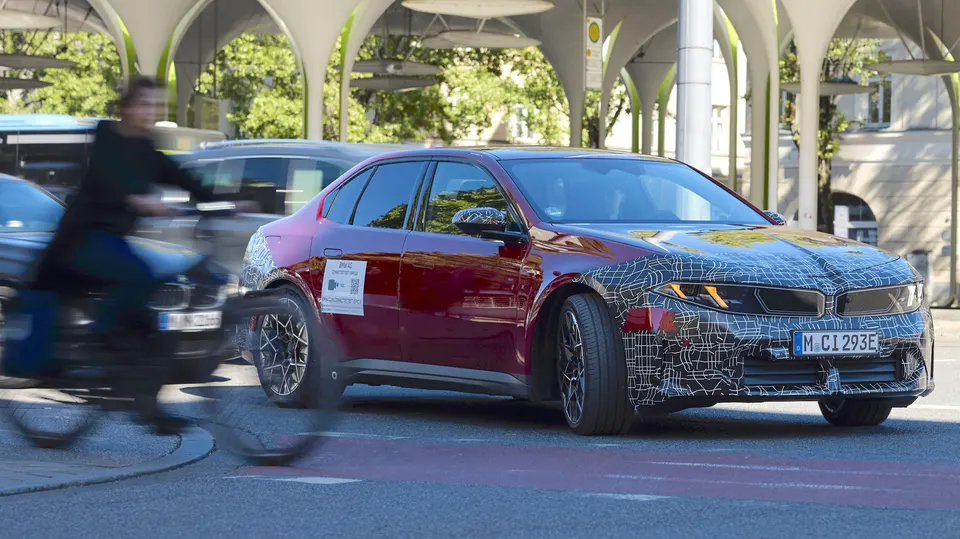
A camouflaged BMW test car navigates city streets, hinting at the hands-off driving tech under development
A camouflaged BMW test car navigates city streets, hinting at the hands-off driving tech under development, Image: Carscoops

Germany first, with other markets to follow

Germany is the first market confirmed for Symbiotic Drive, and BMW says other countries are slated to follow. The company has not named those countries or given a timeline for their launches, so the sequence and dates beyond Germany's 2027 start remain unannounced.

The hardware will be fitted as standard, but activating the system requires an over-the-air software update. BMW has not confirmed what that update will cost. It could carry an extra charge and may take the form of a monthly subscription, though the company has not explicitly said so. Until BMW publishes pricing, buyers should treat the cost of activation as unknown.

Why BMW is stepping back from Level 3

BMW has offered a Level 3 system before, as has Mercedes. Models such as the 7 Series and S Class, when optioned with the right equipment, let drivers hand off duties on select routes, allowing emails, Netflix and video games at 60 mph. Both automakers have temporarily pulled back from Level 3 because of the cost of the lidar equipment it requires and poor customer uptake.

BMW's bet is that the new Level 2 system will prove more useful to drivers while costing less money. That calculation is the more consequential part of the announcement: a hands-off system that works on more roads, in more situations, at a lower price point than lidar-dependent Level 3 tech may reach far more drivers than the highway-only conditional automation it replaces. For buyers of the listed models, the hardware is already in the car, which lowers the barrier to trying it once the software arrives.

What is still unknown

BMW has not announced pricing for the software update or subscription, the full list of countries that will follow Germany, or the timing of those launches. The 2027 date applies to the German market first.

Open this article ↗

Keep scrolling to read the next story.

Older articles →