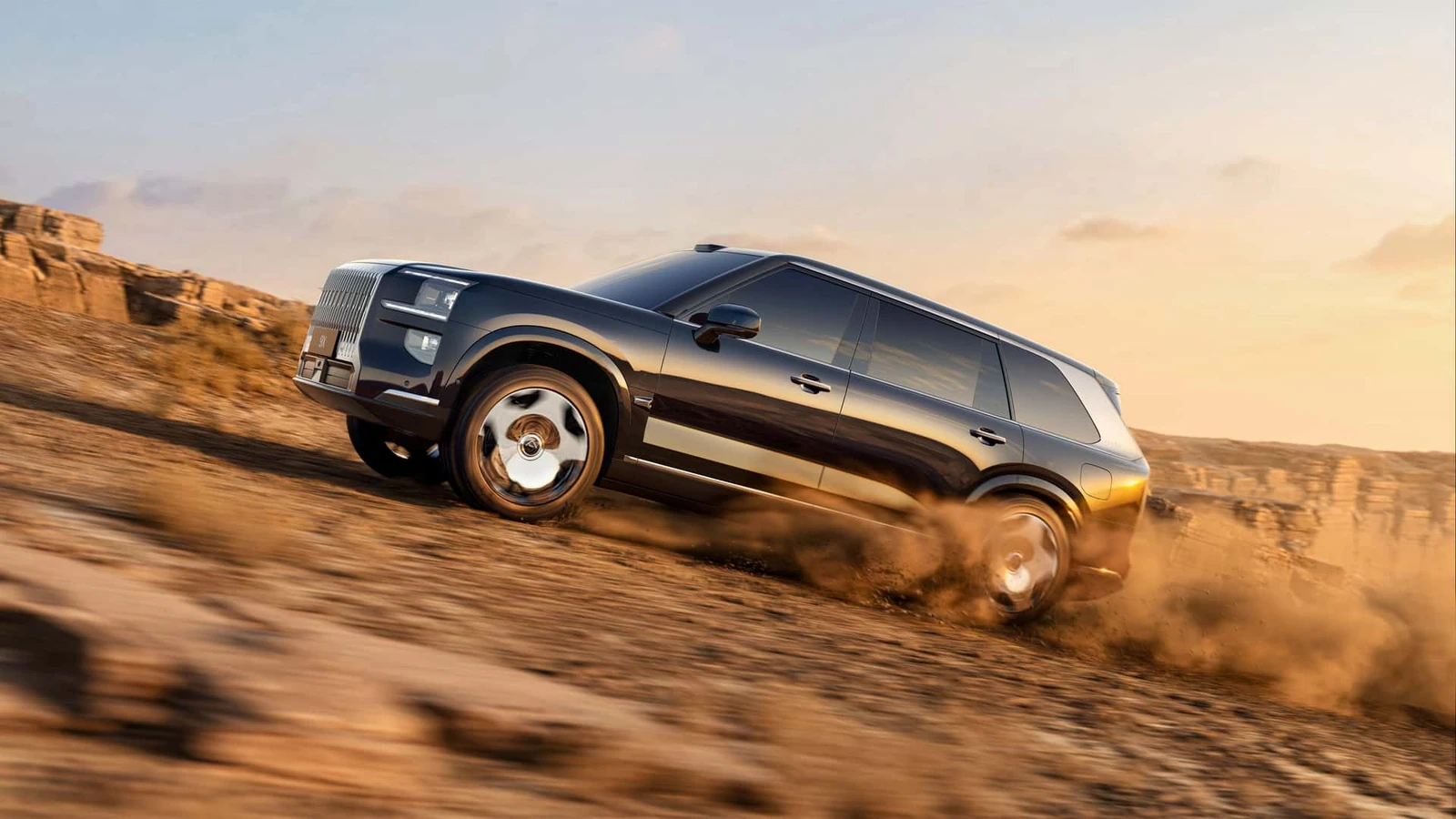
Zeekr's Europe chief executive says the brand will not be deterred from the continent by tightening trade rules, including a newly agreed cap on Chinese hybrid and plug-in hybrid imports, even though he cannot yet say how the company will respond to it. Lothar Schupet told InsideEVs at the Paris auto show that the plug-in hybrid regulations remain "very vague" and that he is not yet in a position to set out a strategy for them.
The cap, agreed by European and Chinese officials days before the interview, limits Chinese hybrid and plug-in hybrid imports to 350,000 units a year. It lands as Zeekr prepares to launch the 9X, a 900-horsepower ultra-luxury plug-in hybrid, in a market where its electric models such as the 7X already carry significant tariffs.
A cap that arrives with the 9X
The timing is awkward for Zeekr. The 9X is a flagship plug-in hybrid pitched at a level of feature content and PHEV technology that, in InsideEVs' assessment, German rivals cannot match, and it now falls under the hybrid cap. The 7X, the brand's rival to the Tesla Model Y, faces steep tariffs on top of a recent mid-cycle update that brought sub-11-minute charge times and a new Bosch advanced driver assistance system.
Schupet was candid that the hybrid rules are not yet clear enough to plan around. "I cannot put a position or a statement now on how we deal with that," he said, adding that the earlier EV tariffs had shown the company it could adapt. In practice, that means Zeekr's response to the hybrid cap specifically has not been announced: the company is watching the detail rather than committing to a volume, pricing or model-mix plan.
Schupet's reading of the crackdown
Rather than treat the restrictions as a rebuke, Schupet frames them as a symptom of Chinese competitiveness. "Are these discussions and regulations coming because we are so successful, or do we have to deal with these things to get success?" he said. "I think it's the first one, that everyone is a little bit scared about what is happening and trying to protect".
That reading is borne out by the wider mood in Europe, where executives and politicians have grown alarmed at their industry's inability to match Chinese products on price even with tariffs in place, and where governments are reluctant to surrender an industry of such high value. The result has been a turn toward regulation and tariffs to buy domestic manufacturers time, a pattern InsideEVs also sees in the United States, where Chinese cars are effectively shut out.
Local investment as the counter-argument
Zeekr's answer is to argue that it is part of the European economy rather than an import-only threat. The company employs design, research and development and corporate staff across several European hubs, and the wider Geely group has invested billions on the continent. Schupet cites the Bosch ADAS fitted to the 7X as evidence of buying into the local supply chain, alongside what he describes as a large existing European supplier network.
"We have now 200 dealers growing to even more," he said. "So there is a big economy driver coming from us as the brand, which no one should underestimate".
The commercial backdrop is strong: Zeekr's European business has grown 200 percent year over year so far in 2026, and the brand is launching products at a rapid pace. That growth is the reason the trade question matters so much. A brand adding dealers and models at that rate needs predictable rules, and a hard import ceiling on plug-in hybrids is precisely the kind of rule that can reshape which variants get pushed in which volumes.
No Australian plans announced
Zeekr's European expansion, the 200 percent growth figure and the 200-dealer network all describe the European market, and the sources do not address Australian sales or pricing. Buyers there should treat the brand's Australian availability and any AUD pricing as unannounced in this material rather than assume the European picture carries over.
Commitment, with the details still open
Schupet's closing position is that Zeekr will absorb whatever the rulebook ends up saying. "We are long term committed in Europe, so we are committed to grow further," he said. "We have heavily invested, and we will invest further. We will be successful here in Europe. So it's more about collaborating than fighting against each other, because we're all sitting in one boat in the automotive industry".
The commitment is clear, but the mechanics are not. Until the hybrid cap is spelled out in detail, Zeekr's European plan rests on local investment, dealer growth and a willingness to adapt, rather than on a stated answer to the 350,000-unit ceiling. For buyers, that means the models and prices on offer in Europe could shift as the rules are finalised, and the 9X's rollout is the one to watch.