INDEPENDENT AUTOMOTIVE NEWSGLOBAL PERSPECTIVE / AUSTRALIAN EDITION
TDCNTHE DAILY
CAR NEWS.

The road ahead.
Every day.

RSS ↗
Latest/New cars

270 original articles

New cars / TDCN ORIGINAL

Subaru WRX longtail prototype spied testing at the Nürburgring

Spy photographers captured a black WRX with extended rear panels and a matching lip spoiler, though the rest of the car appears stock.

Image: Carscoops

A black Subaru WRX prototype with an unusual longtail rear end has been spotted testing at the Nürburgring, according to spy photographs published by Carscoops. The car's front and sides look identical to a standard WRX, but new panels extend outward from the rear quarters and a lip spoiler sits in line with them, giving it a silhouette unlike any current WRX variant.

What is different about this prototype

The modifications are concentrated at the back. New body panels have been attached to the rear quarters and now extend outward, sitting roughly in line with the taillights. A new lip spoiler aligns with these panels, creating a longtail effect. A small piece of camouflage is also visible on a unique rear diffuser.

From the front, the car is unremarkable: same grille, bumper, air intakes and large hood scoop as any other WRX. That is a stark contrast to the large fixed rear wings normally fitted to high-performance WRX models and any potential future STI.
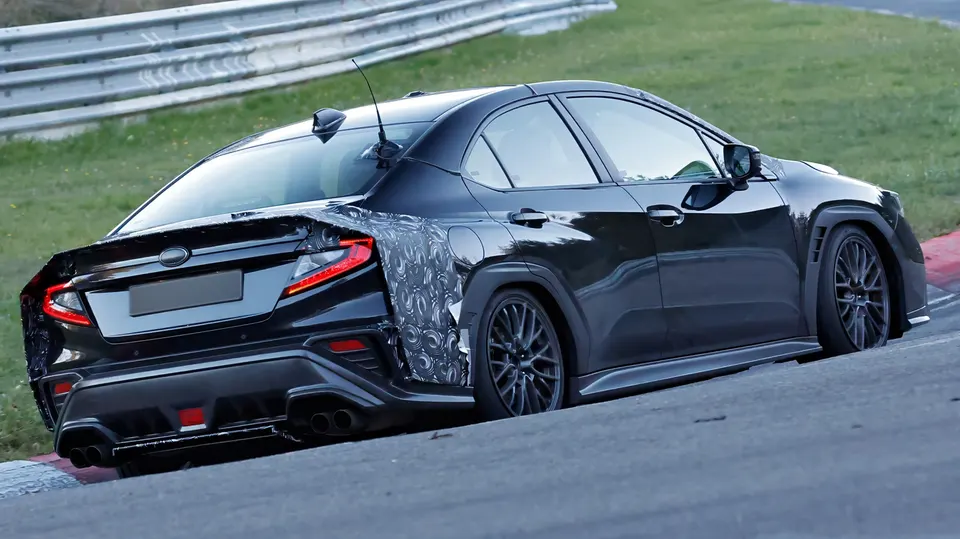
The longtail WRX prototype caught testing, its rear end wrapped in camo and sporting a quad-exhaust diffuser
The longtail WRX prototype caught testing, its rear end wrapped in camo and sporting a quad-exhaust diffuser, Image: Carscoops

Why it may not be an STI

The prototype lacks the enlarged air intakes and bigger brakes that would be expected on a high-performance STI model. It does not even appear to have the same beefy Brembo brake calipers as the regular WRX, so it seems unlikely to have any additional power under the hood.

Subaru has not announced what engine or power output the prototype uses, and the spy photographs offer no clue beyond the standard WRX hardware. The current-generation WRX has been on sale for five years, and Subaru has introduced numerous special, limited-edition versions in markets including Japan and the U.S., yet it still has not launched a proper STI model.

Other possibilities

The longtail rear could be a precursor to another special edition WRX with a distinctive rear end, an optional extra for the standard model, or simply an aerodynamic efficiency study. Carscoops notes that the design is vastly different from the large fixed rear wings expected of new WRX models and any future STI.

The spy images emerged just a week after Subaru announced it is bringing back a manual transmission option to the standard WRX in Japan. That gearbox is unrelated to the TY75 six-speed used in the U.S. model and is instead the same TY85 unit as the previous-generation WRX STI. Subaru is clearly investing time and resources in the current WRX, but the prototype does not confirm a new STI.

What it means for buyers

For anyone waiting on a new STI, this prototype is not proof one is coming. The rear-end work points to aerodynamics or packaging rather than the bigger brakes and intakes that would signal a power upgrade. The smarter read is that Subaru is still developing the current WRX, and a new range-topper would need more than a longtail to justify the badge.
Open this article ↗
New cars / TDCN ORIGINAL

KTM X-Bow GT-XA brings the Austrian track car to US roads at around $490,000

Just 30 examples of the road-legal, canopy-roofed X-Bow will be federalized for American buyers, with orders open now and a $50,000 deposit required.

Image: Carscoops

KTM's X-Bow is finally heading to the United States after almost two decades of absence from the market, in the form of a limited-run road car called the GT-XA. Only 30 examples will be built for American buyers, with prices expected to start at around $490,000.

Orders are already open and require a $50,000 deposit, and if the car is approved for US sale quickly, customer deliveries should begin next year. The federalization work is being handled by KTM's US partner Carbon Yard, which will sell the car through select partners.

What the American X-Bow is

The GT-XA closely follows the GT-XR that KTM has sold in Europe for several years. Unlike the original open X-Bow, both cars carry a full windshield and a canopy-style roof, which makes them a little more usable on the road.

The car is built around a lightweight carbon fibre monocoque and draws heavily on the GTX and GT2 race cars KTM produces. Its signature feature is a jet-fighter-inspired canopy that lifts from the bodywork along with the carbon fibre roof, windshield and side windows. Fixed seats are standard, with an adjustable pedal box and steering wheel letting owners set their driving position.

KTM says American cars get their own touches: a new suspension system with adjustable compression and rebound, a front-axle lift system and tyre-pressure monitoring. Buyers can also specify custom materials, colours, trim and interior stitching. The company's stated aim is to pair the X-Bow's track ability with more composure and comfort on the street.

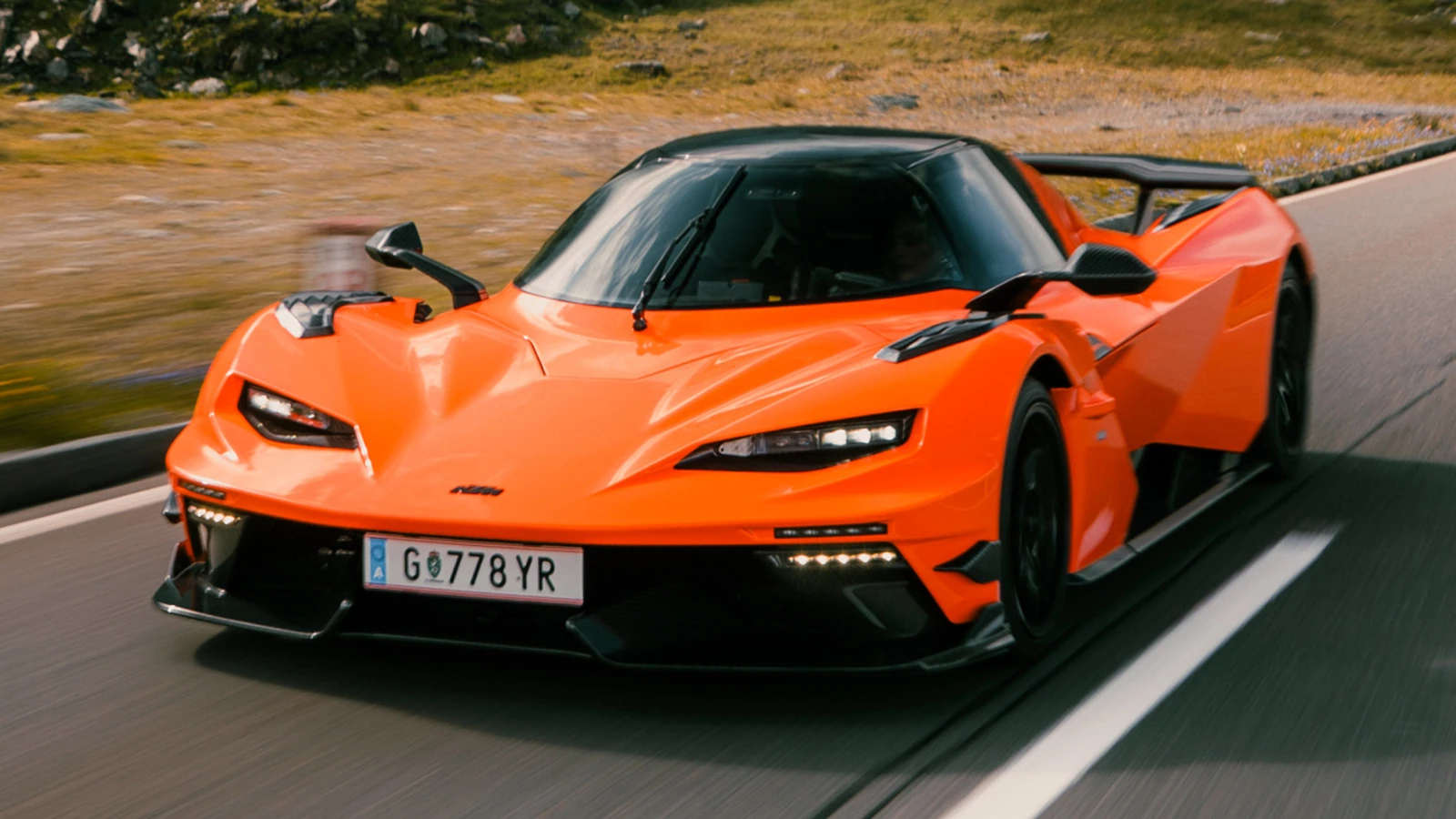
The X-Bow GT-XA on the move: KTM's Austrian track special now aimed at US roads.
The X-Bow GT-XA on the move: KTM's Austrian track special now aimed at US roads., Image: Carscoops

Engine and drivetrain

The GT-XA is expected to largely mirror the GT-XR, which has been updated for 2027 with a Factory 600 package. That version uses Audi's turbocharged 2.5-litre five-cylinder engine with a new turbo, intake manifold and larger intercooler, producing 592 horsepower. It drives the rear wheels through a dual-clutch transmission and a mechanical limited-slip differential.

Because the American car is described as closely following the European one, that powertrain is the benchmark buyers can reasonably expect, though KTM has not spelled out a separate US output figure. Either way, 592 hp in a carbon monocoque car with a race-derived chassis puts the GT-XA in rare territory among road-legal machines.

How the cars are built and sold

Each GT-XA will be hand-built at KTM's facility, and owners get time with engineers plus access to exclusive driving experiences, including at the Red Bull Ring. Carbon Yard is running US operations and will distribute the car through selected partners.

The price is described as expected rather than final: Carscoops puts the starting point at around $490,000, just under the half-million-dollar mark. For a car built in a run of 30, the combination of hand assembly, a bespoke suspension set-up and factory driving events is a large part of what the money buys.

KTM's hard road back

The launch lands after a difficult stretch for KTM. The company ran into serious financial trouble in 2024 and entered self-administration while carrying hundreds of millions of euros of debt. Its motorcycle business was sold to India's Bajaj Auto, and the operation behind the X-Bow was split off into a separate company, now backed by a Belgian investment consortium that includes racing driver Guillaume de Mévius.

That split matters for American buyers: the X-Bow side of the business is now a distinct entity with its own backers, and the GT-XA is its first serious push into the US. For drivers, the appeal is a road-legal machine with genuine race-car bones, sold in a number small enough that each car is effectively a bespoke build. The catch is that the US price and delivery timing still hinge on federal approval, which has not yet been confirmed.

Open this article ↗

Keep scrolling to read the next story.

Older articles →