INDEPENDENT AUTOMOTIVE NEWSGLOBAL PERSPECTIVE / AUSTRALIAN EDITION
TDCNTHE DAILY
CAR NEWS.

The road ahead.
Every day.

RSS ↗
Latest/Electric

284 original articles

Electric / TDCN ORIGINAL

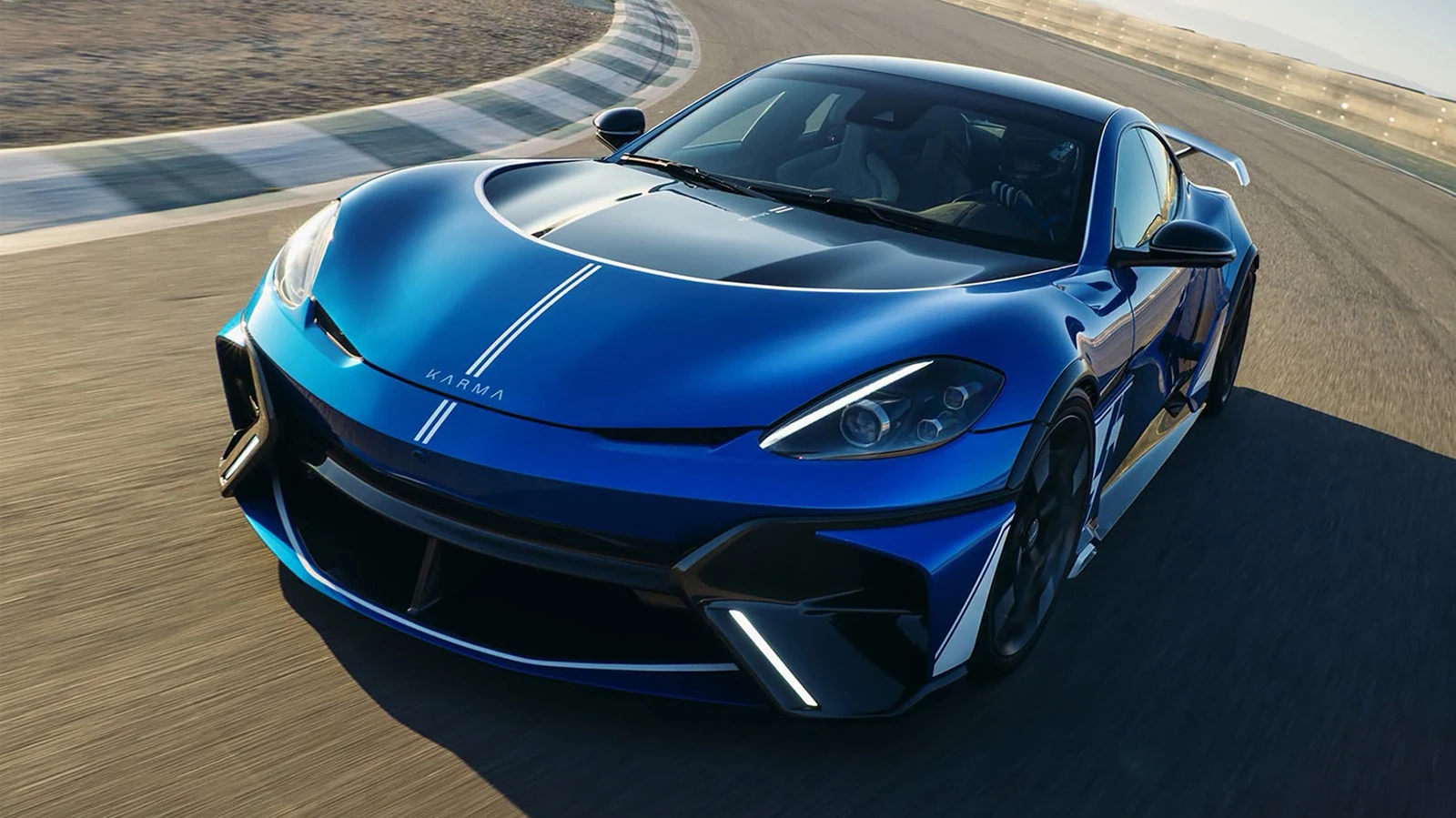
Karma reveals Eximius 1, a 1,200 hp V8 plug-in hybrid one-off

The first of nine bespoke commissions pairs a 6.2-litre V8 with electric motors for a claimed 2.7-second 0-60 mph time, with delivery set for 2027.

Image: Carscoops

Karma Automotive has unveiled the Eximius 1, the first of nine one-off commissions built under a new bespoke programme for selected clients. The track-focused four-seater pairs a 6.2-litre V8 with electric motors for a combined output of around 1,200 hp.

The car is scheduled to be delivered in 2027 and will not be repeated. Karma has not disclosed pricing.

A Gyesera underneath, but almost nothing else carries over

The Eximius 1 is recognisably related to the Gyesera, the model that replaced the discontinued Revero, itself an evolution of the 2011 Fisker Karma. The greenhouse, roofline, lights and doors are carried over from that donor car, but Karma says everything else has changed.

The bodykit brings new front and rear bumpers with large intakes and outlets, diagonal daytime running lights, a vented hood, carbon fibre fender extensions, wider side skirts with aerodynamic fins, a complex diffuser and a fixed rear spoiler. It is finished in Borealis Blue with white graphics and exposed carbon fibre.

Inside there are four Recaro bucket seats trimmed in Alcantara in Borealis Blue and Moondust, along with a substantial amount of carbon fibre. A motorsport-style emergency kill switch sits on the centre console, and a custom carbon racing helmet is mounted between the rear seats.
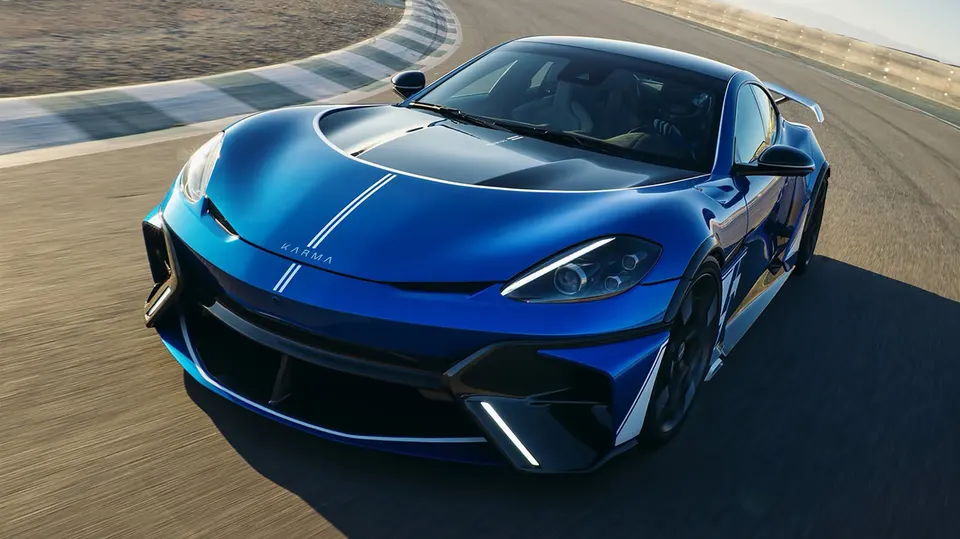
The Eximius 1's aggressive front end hints at the Gyesera beneath, though little else carries over
The Eximius 1's aggressive front end hints at the Gyesera beneath, though little else carries over, Image: Carscoops

V8 plus electric motors, and a 200 mph target

Karma quotes a combined output of around 1,200 hp, split between 550 hp from the combustion engine and 650 hp from the electric motors. Carscoops notes the 6.2-litre V8 sounds like a General Motors unit.

That output is claimed to push the four-seater from 0-60 mph (0-96 km/h) in 2.7 seconds and on to a top speed above 200 mph (322 km/h). Karma describes it as the most powerful plug-in hybrid ever developed.

Karma has not published an electric-only range figure or a battery capacity for the Eximius 1. The car is a series plug-in hybrid, meaning the V8 acts as a generator for the electric drive rather than driving the wheels directly, but no further powertrain detail has been released.

Chassis work aimed at the track

The one-off is understood to sit on the aluminium spaceframe that dates back to the Fisker era. It gains semi-active Öhlins suspension, a wider track, and carbon-ceramic brakes with two-piece slotted rotors behind 21-inch magnesium wheels.

Those changes matter more than the power figure for a car pitched at track use. Big output is easy to quote; keeping a four-seat hybrid stable and fade-free over repeated laps is the harder engineering problem, and the Öhlins dampers and carbon-ceramic brakes are the parts that address it directly.

Nine clients, nine cars, no repeats

Karma's bespoke programme will produce nine one-offs in total, each with unique styling and mechanical modifications for a single client. The Eximius 1 is the first of them.

Marques McCammon, president and CEO of Karma Automotive, said the project "began as a conversation with an elite client who loves their Karma Revero, but wanted something more extreme and unexpected".

Karma has not announced pricing for the Eximius 1. Given the extent of the changes, Carscoops expects it could be the most expensive Karma yet, though that is the outlet's assessment rather than a confirmed figure.
Open this article ↗
Electric / TDCN ORIGINAL

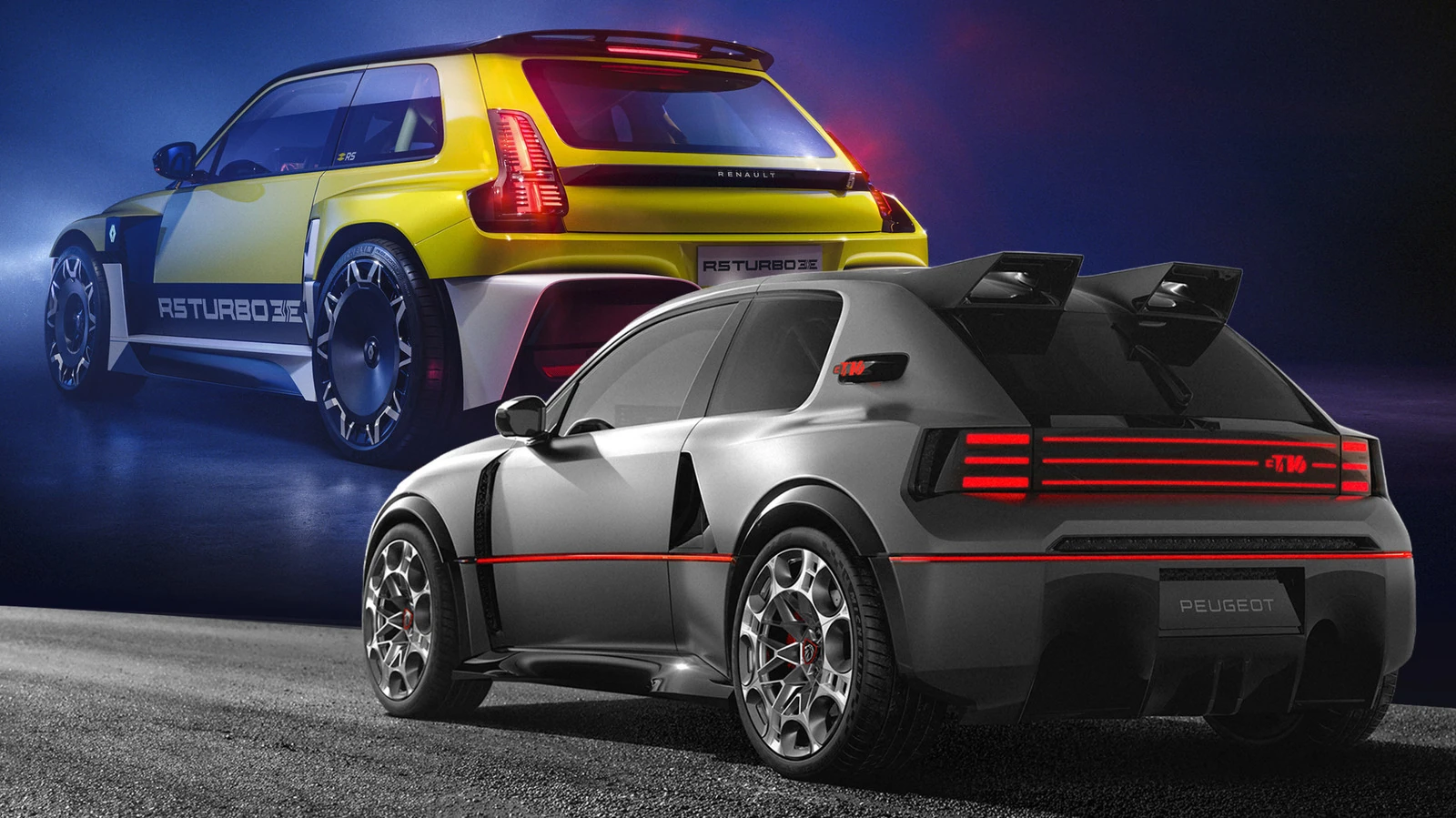
Renault's electric R5 Turbo 3E puts 555 hp through the rear wheels for €160,000

The limited-run Group B tribute is rear-wheel drive with a 70 kWh battery, while Peugeot's rival e-T16 concept counters with three motors and 816 hp.

Image: Carscoops

Renault has turned its 2022 Turbo 3E show car into a limited-production electric hyper hatch, the R5 Turbo 3E, priced from €160,000 and capped at 1,980 units. Orders are open in Europe, the UK, the Middle East, Japan and Australia, with first deliveries expected in 2027.

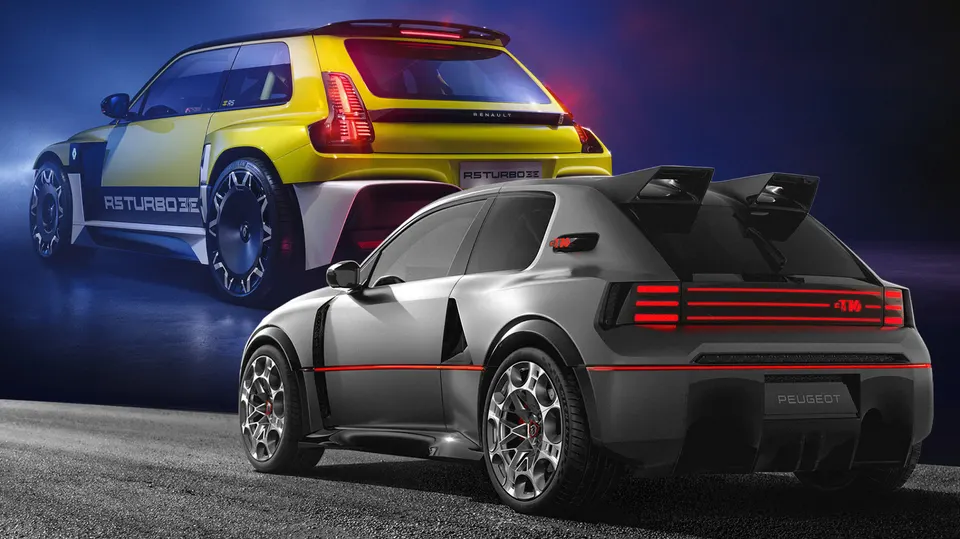
The car is a modern tribute to the mid-engined, rear-wheel-drive Renault 5 Maxi Turbo rally car, and it arrives alongside a Peugeot counterpart, the e-T16 concept, that revives the 205 T16 lineage in electric form.

Two French takes on the Group B idea

Renault's car is a flagship performance EV that sits between the classic R5 Turbo and the new R5 E-Tech road car. Peugeot's e-T16, by contrast, is a disguised preview of the next 208 hatchback due in 2027, and the brand's boss has said it could become a production model as early as that year.

That difference in intent matters for buyers. Renault is selling a finished, numbered special; Peugeot is still showing a concept whose production form, and whether it keeps its tilting rear bodywork, has not been confirmed.

Renault's powertrain and chassis

The R5 Turbo 3E uses a bespoke aluminium tubular chassis developed by Alpine and a floor-mounted 70 kWh battery, giving a 43/57 weight distribution. Dual electric motors produce a combined 555 hp (410 kW/563 PS), good for 0-100 km/h in under 3.5 seconds.

It weighs 1,450 kg and drives the rear wheels only, matching the layout of the original. Renault quotes a 15-80% charge in about 15 minutes on a suitably powerful charger.

The car rides on 20-inch alloy wheels and wears wide fenders with integrated vents, deep side skirts, a large rear diffuser and a roof spoiler, and it keeps a three-door layout. Inside are two heavily bolstered bucket seats, a roll cage, a conventional steering wheel and a digital cockpit derived from the R5 E-Tech, plus a vertical hydraulic handbrake for hairpins. It also has a regular boot.

The R5 Turbo 3E channels its 555 hp through the rear wheels, a modern take on the Group B recipe
The R5 Turbo 3E channels its 555 hp through the rear wheels, a modern take on the Group B recipe, Image: Carscoops

Peugeot's concept counters with more power

The e-T16 concept uses Stellantis' STLA One architecture and three electric motors making a combined 816 hp (600 kW/827 PS), with all-wheel drive in the spirit of the 205 T16. Peugeot claims 0-100 km/h in 2.5 seconds.

Its 85 kWh battery is said to be enough for three consecutive laps of the Nürburgring, and Peugeot quotes a 10-80% charge in about 15 minutes. The company has not published a kerb weight, but states a power-to-weight ratio of under 2 kg/hp, which points to roughly 1,632 kg.

It sits on 21-inch alloys with wider rear tyres, and its styling includes three-slot full-width LED graphics front and rear that Peugeot intends to make a signature of future models. The interior features a Hypersquare steering wheel with an integrated display, a 21-inch digital cluster, two bucket seats, a roll cage and the same style of vertical hydraulic handbrake. Its entire rear bodywork tilts open to expose the motors and suspension.

What buyers still cannot know

No back-to-back driving comparison of the two has been published yet, so the specs are the only basis for choosing between them for now. Peugeot has also not confirmed final production specifications, pricing or market availability for the e-T16.

On paper the Peugeot's three-motor, all-wheel-drive layout and 816 hp outgun the Renault, and its sub-2 kg/hp claim suggests a power-to-weight advantage despite the extra mass. The Renault's answer is the lighter kerb weight, the rear-drive layout that echoes the original Maxi Turbo, and the fact that it is a real, orderable car rather than a show stand preview. For a collector weighing up a place in the garage, that last point is the one that counts today.

Open this article ↗

Keep scrolling to read the next story.

Older articles →