Ford has gathered more than 100 vehicles, among them concepts, one-offs and studio models never shown publicly, into a new collection called the Ford Vault, housed in a former Amazon fulfilment centre between Ann Arbor and Detroit. The project began three years ago after CEO Jim Farley saw the collection Ford had assembled in England, according to Ford archive and heritage brand manager Ted Ryan.
What is on display
The Vault is not a second Henry Ford Museum: it is Ford-centric, and it mixes production landmarks with memorabilia, signage, a kitchen and even an arcade game. Among the cars is a 2000 Ford Contour SVT with just 123 miles on the odometer and its window sticker still attached.
The collection also draws on vehicles owned by others. Jay Leno's 1934 Ford pickup is on show, the Cougar II concept is on loan from the Detroit Historical Society, and four blue police cars dating back to 1957 come from the Michigan State Police.
The exhibit is organised around themes including "Answering The Call", "America's Race Team" and "Backbone of Work", with a separate design pillar that holds the rarest material.
The prototypes that survived the crusher
The most striking exhibit may be a V10-powered New Edge Mustang GT that served as a development mule for the Cobra R and GT programmes. Ford engineers originally swapped the Mustang's 4.6-litre V8 for a 5.4-litre unit, then fitted a naturally aspirated V10 while the 2005 GT was being developed with several engine options under consideration; the GT ultimately received a supercharged V8 and the mule should have been crushed.
"We couldn't crush this car," Ford Racing heritage business manager Nick Terzes said, explaining that the prototype was moved from group to group and hidden away rather than destroyed.
The car is still doing work. Because Ford lacked a powertrain control module that could run at the speeds a 10-cylinder needed, the mule originally used two PCMs; it has since been given a new PCM and an all-new harness, and Terzes said it made a lot more power and is still used for learnings today.
That matters because it makes the Vault something other than a static museum: at least one exhibit is still a working engineering tool, which is a more honest way to tell a development story than polishing a show car.
Design studies shown for the first time
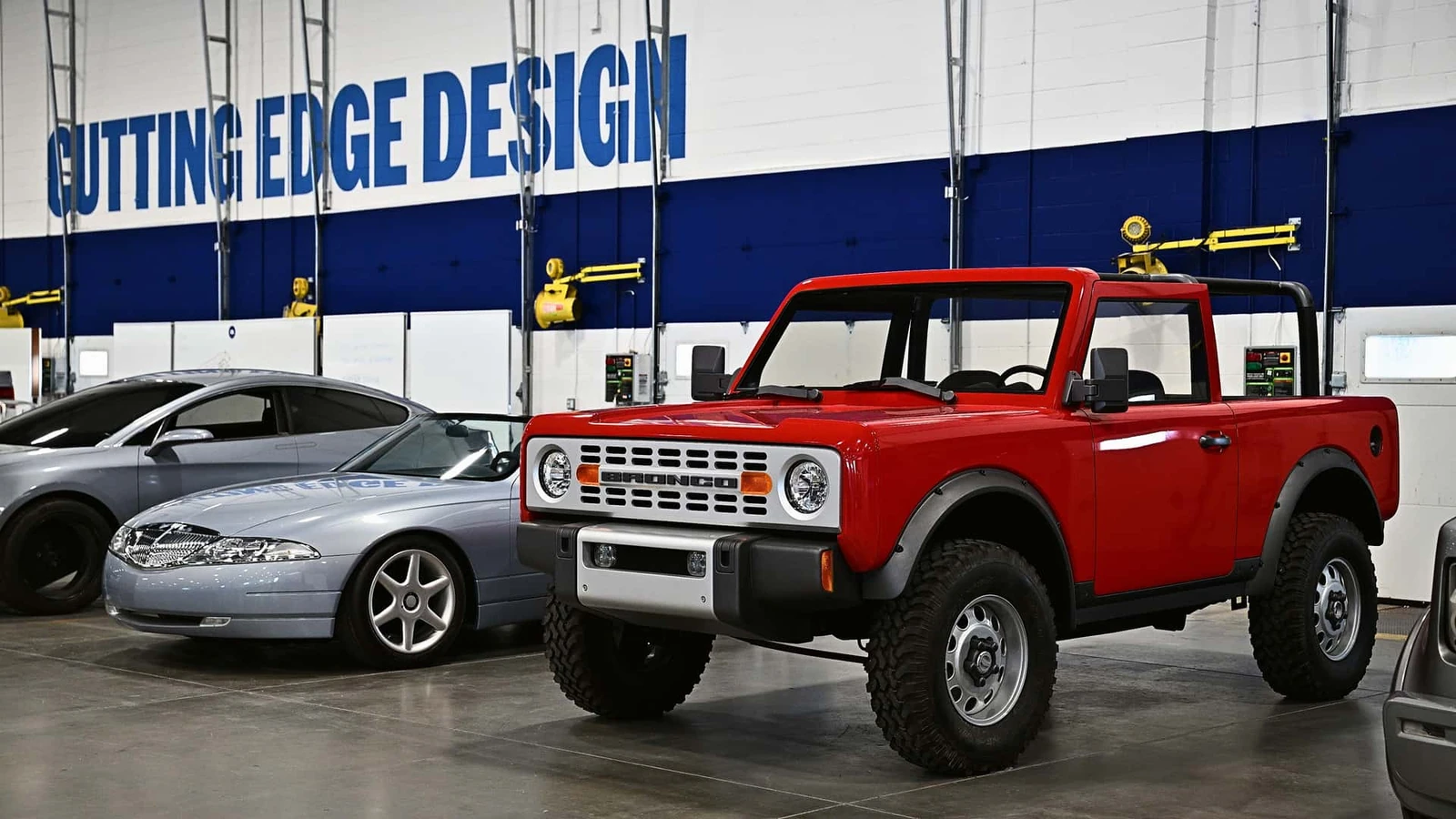
The design pillar includes an early Ford Bronco design study, created to persuade management to revive the nameplate as a proper off-road SUV, displayed publicly for the first time next to the 2005 Ford SYNus concept. The Bronco study is not a complete model: it has no proper interior, only the tops of the headrests and the steering wheel.
Also on the floor is a compact studio reference model made from high-density foam that served as an early Focus prototype, with a cab-forward design and aerodynamic shape created to study how to maximise interior space. The elusive Ford UXC concept, which looks like a four-door version of the last Mercury Cougar, is displayed as well.
For car buyers, these are the artefacts that explain how the road cars they can actually purchase came to look and package the way they do, which is a more useful kind of heritage than a row of polished production models.
Public access is not settled
Ford is working with the City of Romulus to update the property's zoning and meet building codes so the public can visit, but the automaker has given no timeline for when that could happen. Until then, the Vault is a collection assembled and guarded rather than a destination with opening hours, so anyone hoping to see the Contour SVT or the V10 mule in person has no date to plan around.