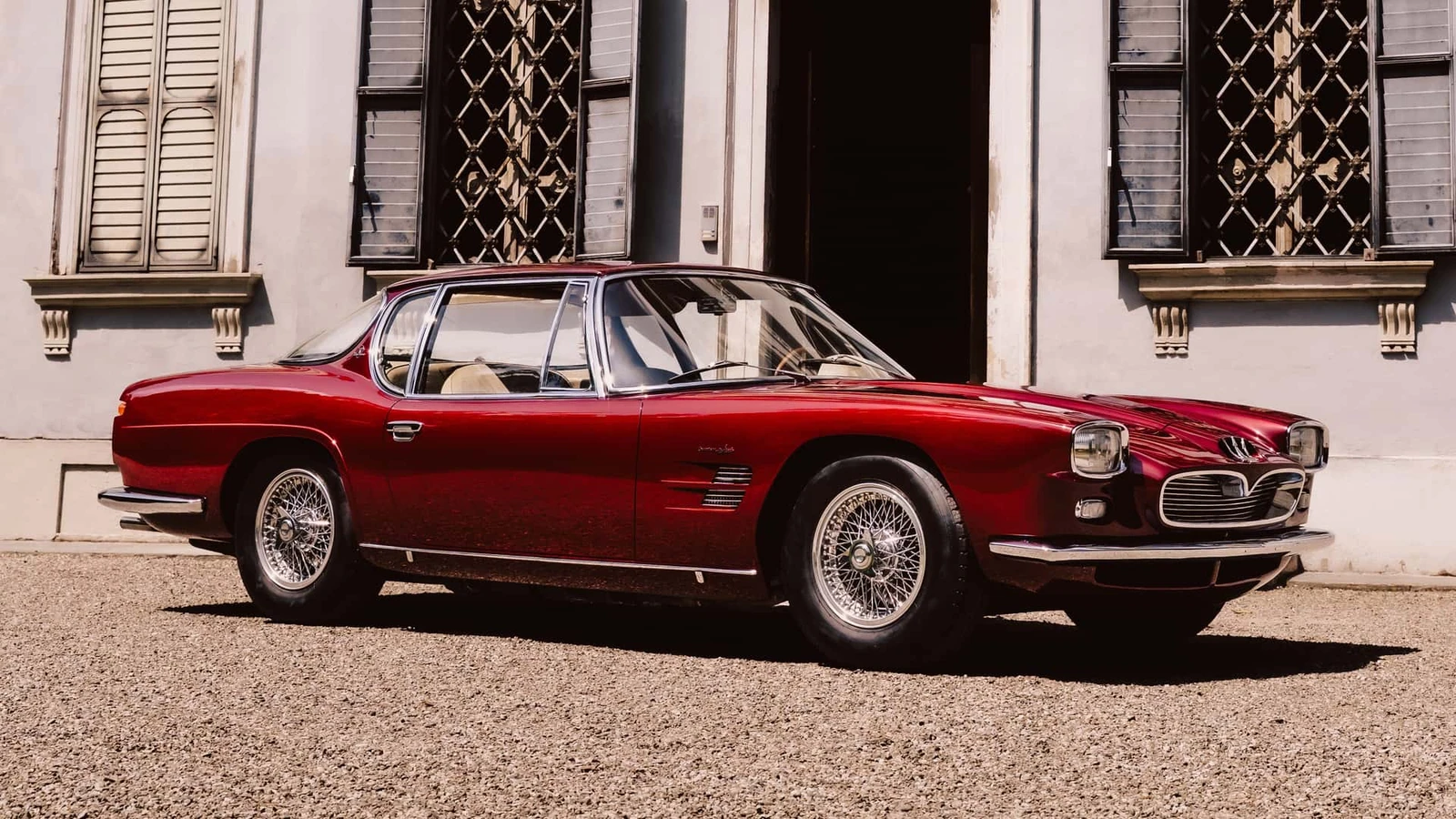
Maserati has awarded its Classiche certification to chassis 103*064*, the first 5000 GT ever clothed by Pietro Frua and a car that spent more than three decades impounded in a Cairo warehouse. The authentication confirms the car's originality using the factory's own archives and technical inspection, and makes it the first 5000 GT Frua to carry the badge.
Only 34 examples of the 5000 GT were built between 1959 and the mid-1960s, and just three of those wore Frua bodywork.
A grand tourer born from a shah's request
The 5000 GT exists because the Shah of Persia drove a Maserati 3500 GT and wanted something grander. Technical director Giulio Alfieri answered with project AM103: a 5.0-liter V8 derived from the Maserati 450S race car, dropped into a road-going grand tourer rated at over 350 hp.
Carrozzeria Touring built the first three cars, shown at the 1959 Turin Auto Show and nicknamed the
Shah of Persia
after their instigator. Maserati then opened the AM103 platform to other coachbuilders, and Allemano, Pininfarina, Monterosa, Ghia and finally Frua each draped their own body over the same mechanicals.
Pietro Frua built his three 5000 GTs in 1962, and chassis 103*064* was the first. It wore a
Luci di Mezzanotte
exterior over
Camoscio
interior, with a lower beltline and larger glass area that made it sleeker than the Touring and Allemano cars before it.
Royal owners, then 30 years in a Cairo warehouse
Maserati used the car for testing before displaying it at the 1963 Geneva Motor Show, where Karim Aga Khan IV drove it and ordered a 5000 GT Frua of his own.
The prototype returned to Modena at the end of 1963 and was sold to a new owner in Rome. In January 1966 that owner traded it back to the factory against a newer Maserati, and the car was repainted
Rosso Rubino Chiaro
at the request of its next buyer, Saudi Prince Magid Ben Saoud.
Magid gave the car to his father, King Saud bin Abdulaziz Al Saud, and that gift set off the strangest chapter of its life. Egyptian authorities seized it in 1967 after the Six-Day War and the king's departure from Egypt, and it then sat impounded in a Cairo warehouse for more than three decades.
Rescue, restoration and factory certification
When the car resurfaced in 2000 it had covered roughly 7,900 miles and still carried its major components. A Texas collector bought it and shipped it back to Modena, where a four-year restoration preceded its reappearing at the 2004 Concorso d'Eleganza Villa d'Este.
The Classiche certification now attached to the car verifies the authenticity of historic models against factory archives and technical checks. Maserati's Fuoriserie and Bottega studio, launched in 2021, handle bespoke work for current and classic cars, and the restoration sits in the same tradition as one-off projects such as the GT2 Stradale tribute.
For collectors, the certification is the meaningful part: with only 34 5000 GTs built and three of them Frua cars, factory-verified provenance is what underpins value at auction. What the car is worth now, or when it might next change hands, has not been announced.